

State Aid Law Blog

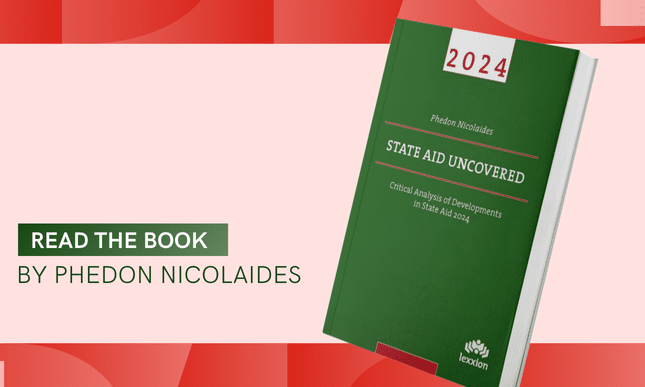
State Aid Uncovered Blog

In Lexxion’s State Aid Uncovered blog, Prof. Phedon Nicolaides publishes weekly critical analyses of recent State aid judgments and decisions. Each post presents the key points of a court judgment or EU Commission decision, places it in the context of similar case law or practice, assesses the underlying reasoning and highlights any inconsistencies or contradictions.

Guest contributions from other State aid experts will also be published on the blog at irregular intervals to complement the content of the blog posts.

Subscribe now!

Support for the Decarbonisation of the Electricity Sector through Storage Capacity

State Aid Blogs - Untitled design 1
Introduction Romania notified a scheme to support investment in large-scale electricity storage. The Commission approved it in decision SA.102761.[1] The scheme was part of the national Recovery and Resilience Plan [RRP] of Romania and was co-financed by the EU’s Recovery and Resilience Facility. By supporting investment in electricity storage, Romania aimed to reduce carbon emissions generated by the energy sector, […]

Development of Affordable Housing

Introduction The provision of social housing can be designated as a service of general economic interest and can be publicly funded under the Commission decision 2021/21. Member States have to show that there is a real social need and limit access to social housing to those persons who cannot afford what the market provides; i.e. low-income or vulnerable persons such […]

State aid Scoreboard, 2022

Introduction On 24 April 2023, the Commission released the 2022 version of the State aid Scoreboard which this year runs to a record 226 pages.[1] It covers the State aid that was granted in 2021 and contains information on both covid-19 measures and non-pandemic aid. Covid-19 related aid reached EUR 191 billion, or 57% of total aid expenditure. Non-crisis aid […]

German Risk Finance

Introduction Relatively few risk finance measures are notified to the Commission as Member States use Articles 21 and 22 of the GBER to support investments in SMEs and start-ups. However, the GBER excludes from its scope tax incentives for investments by undertakings. Tax incentives are possible only for investments by private investors. For this reason, Germany recently notified an aid […]

Imposition of Public Service Obligations through Extension of a Concession

Introduction It has recently been confirmed in the case law that Member States are not obliged to implement a procurement procedure when they grant State aid. This means, of course, that the public funds they provide do confer an advantage on their recipient undertakings. Compliance with public procurement procedures affects the compatibility of the aid with the internal market. Indeed, […]

Update of Commission Guiding Templates on Funding by the Recovery and Resilience Facility

Introduction In December 2020, the European Commission published “templates” to help Member States in the design of their plans that were to be financed by the Recovery and Resilience Facility [RRF]. The purpose of the templates was to identify whether those plans contained State aid and, if they did, whether the aid had to be notified or not. Soon afterwards […]

Compensation for Damage Caused by COVID-19 Combined with Rescue Aid

Introduction Member States are allowed to grant state to compensate undertakings for damage they suffer as a result of a natural disaster or exceptional occurrence. But, it is not always easy or possible to disentangle the damage caused by such an unforeseen event from losses caused by mismanagement or changes of market conditions. The art and science of calculating the […]

A More Comprehensive and Generous GBER

Introduction In a Communication that was published on 9 March 2023, the Commission announced extensive amendments to the GBER.[1] A 100-page annex to the Communication provided the legal text of the draft regulation that would revise Regulation 651/2014.[2] The amendments aim to: Ensure consistency between the GBER and new State aid guidelines. Bring the GBER in line with the EU […]

A Visionary XXX FIDE Congress Approaching

We’re happy to announce that Lexxion publisher has become a media partner to the FIDE Congress, one of the most distinguished events on EU law. Of particular interest for the readers of the State Aid blog and the EStAL quarterly is the second topic of the congress, dedicated to the new geopolitical dimension of the EU competition and trade policies. […]

Charging Infrastructure for Electric Vehicles

Introduction As part of the EU’s Green Deal and the transition to a greener and most sustainable economy, the European Commission’s guidelines on State aid for climate, environmental protection and energy [CEEAG] also allow public support for the construction of energy infrastructures. In a recent decision, the Commission approved a German State aid scheme [SA.104749] for high-power charging infrastructure for […]

Legal Standing of Competitors

State Aid Blogs - State Aid Uncovered SM posts 18
A Commission decision authorising or prohibiting a state aid measure that can be implemented without any intermediate rules is a “regulatory act” that can be challenged by “directly concerned” undertakings. Introduction Any natural or legal person who is the addressee of an act of an EU institution can challenge that act before EU courts. This is a right that is […]

Economic Activities of a Research Organisation (Part I)

The revenue from the economic activities of a research organisation must cover the full cost of those activities. Introduction Member States use extensively the GBER to support R&D schemes. If we exclude the measures that were implemented in the context of covid-19 and now those which are financed by the recovery and resilience fund, not more than a dozen measures […]

The State Behaving Like a Private Land Owner

A private land owner changes rent at market rates. But it may accept lower rent if the user of the land incurs costs to improve it. Comparative analysis to determine the market value of land must take into account not only the particularities of the various land plots, but also the particularities of the various rental contracts. Introduction When the […]

State Guarantees without State Aid

Introduction State guarantees may constitute State aid if they are not priced at market rates. A properly priced guarantee reflects the risk assumed by the public authority that issues it and the collateral, if any, that the beneficiary undertaking can pledge. The State aid that is embedded in a guarantee that is priced below the relevant market rate is operating […]

Why Grant a Loan to an Undertaking in Difficulty?

When a market operator invests in an undertaking in difficulty it also considers the possibility of restructuring, sale or closure. Introduction The answer to the question posed in the title of this article is “because the loan enables the undertaking to become viable again and repay the loan with interest”. It is now well established in the case law that […]

Individual Aid to Counter the Effects of Serious Economic Disturbance Is Legally Possible, but Is it Appropriate?

Individual aid need not be capable itself to remedy serious economic disturbance in the economy of a Member State. It is sufficient that it contributes to that effect. Introduction On 22 June 2022, in case T‑657/20, Ryanair v European Commission, the General Court confirmed once more that Member States have a right to grant State aid to the undertakings of […]

The Date on which State Aid is Deemed to be Granted Is not necessarily the Date on which the Actual Benefit Materialises

State aid is deemed to be granted even if the benefit cannot be quantified in advance and even if state resources are transferred at a future point in time. Introduction The precise date on which State aid is granted can be important such as, for example, when calculating the present value of aid granted in tranches at different points in […]

Territoriality and the Tax Treatment of Intra-group Transactions

A special tax rule can constitute the reference or normal system of taxation if it is “severable” from other tax rules and has its own legal logic. Introduction The application of State aid rules to the tax treatment of transactions between companies that belong to the same multinational group is contentious. During the past three years or so, the Commission […]

A Rare Commission Decision on SGEI Interpreting Decision 2012/21

A non-profit provider of free services which are in competition with similar services on the market is an undertaking. Introduction The decentralisation of State aid policy of the past decade has made it easier for the Member States to achieve their public policy objectives. By using blog exemption regulations and decisions, they can grant State aid faster, without having to […]

State Aid and Anti-Competitive Practices

State aid to undertakings that engage in anti-competitive practices is incompatible with the internal market. Introduction For State aid to be compatible with the internal market, it may not infringe any other provision of the Treaty or secondary legislation. Occasionally, the Commission finds State aid measures to be incompatible with the internal market because they contain clauses that exclude foreign […]

Subscribe to our newsletter for updates on legal developments, upcoming conferences, workshops, and publications in your areas of interest.

Newsletter: Subscribe now