

Executive Summary
- Granting state aid following an auction procedure minimises the amount of aid and ensures that it supports the most efficient companies.
- Granting state aid in the form of a fixed premium per kg of output incentivises producers to reduce their costs over time.
- The European Commission’s “Auctions-as-a-Service” limit distortions in the internal market.
Table of Contents
- Introduction
- Beneficiaries
- Eligible technology
- Form of the aid, budget and aid allocation process
- Reference projects
- Compatibility assessment
- Incentive effect and necessity of the aid
- Proportionality of the aid
- No undue negative effects
Introduction
Since 2023, certain Member States have supported the production of hydrogen from renewable fuels of non-biological origin [RFNBOs] using a methodology developed by the Commission to determine the necessary amount of state aid. This methodology is based on the concept of the European Hydrogen Bank Auctions-as-a-Service [AaaS].[1] The Commission organises an EEA-wide auction that identifies the most efficient producers who are then supported with resources from the EU’s Innovation Fund. The next most efficient bidders whose projects meet all the criteria, except price, and therefore do not receive funding from the Innovation Fund are eligible for funding from their Member States in the form of state aid. The Commission is in a position to approve such aid quickly because it conforms with the terms of the auction that is designed by the Commission itself. This approach minimises distortions to competition in the internal market because companies from across the EEA can participate in the auction process.
In March 2026, the Commission approved a Spanish scheme for the European Hydrogen Bank AaaS [SA.121244].[2] The ultimate objective of the scheme is to support the production of renewable hydrogen through electrolysis in order to contribute to the reduction of greenhouse gas [GHG] emissions.
Directive 2023/2413 on the promotion of the use of energy from renewable sources requires Member States to ensure that RFNBOs make up at least 42% of the hydrogen used in industry by 2030, and 60% by 2035.
As explained in the Commission decision, “(9) with the view to stimulating and supporting investment in sustainable hydrogen production through a European Hydrogen Bank, the Commission’s Communication [on the European Hydrogen Bank, COM/2023/156 final] announced key design elements of the pilot auction for hydrogen that meets the criteria for RFNBOs developed under the EU regulatory framework (“RFNBO hydrogen”), which was launched in 2023. The European Hydrogen Bank Communication observed that EU-domestic production of RFNBO hydrogen still faces a considerable funding gap and should be supported financially through competitive bidding (auctions) under the EU Innovation Fund”.
The Innovation Fund was established under Article 10a(8) of Directive 2003/87 on greenhouse gas emission allowance trading. The Innovation Fund provides support grants through and auctions [i.e. competitive bidding]. The use of auctions is intended to ensure cost-efficient support to hydrogen producers.
In December 2025, the Commission opened the third auction under the Innovation Fund [the previous two were held in 2023 and 2024] to support investment in RFNBO hydrogen production through the European Hydrogen Bank.
The state aid implication from these auctions is that “(13) under the concept of Auctions-as-a-Service, which is a feature of the 2025 Innovation Fund auction, Member States may choose to use the 2025 Innovation Fund auction mechanism to also allocate a pre-defined amount of national funding to RFNBO hydrogen production projects located on their territory … These projects will be assessed and ranked in the competitive auction procedure under the 2025 Innovation Fund auction and can become eligible for national funding if the Innovation Fund budget is insufficient to cover those projects. The scheme is intended to finance RFNBO hydrogen production projects under the same conditions as those applicable to projects financed directly by the Innovation Fund”.
“(14) Auctions-as-a-Service are aimed at harmonising, and tying together national and European support schemes, increasing the comparability of price points from subsidy schemes, and saving on the administrative costs of Member States and project developers for developing and understanding various and different hydrogen support schemes.”
At present, RFNBO hydrogen is significantly more expensive to produce than hydrogen from fossil fuels. It is hoped that “ramping up electrolysis capacity” will improve understanding of the technology and lead to cost reduction. Apparently, electrolyser costs have declined by 60% over the past decade as a result of economies of scale. These costs are expected to decline further.
“(17) Spain maintains that, although the EU Emissions Trading System (“EU ETS”) partially addresses the existing market failure regarding RFNBO hydrogen, the EU ETS price alone is insufficient to incentivise investments in electrolysis projects. Spain states that in the absence of stronger sufficient price signals from the EU ETS or other regulatory interventions such as Union standards, potential European consumers of RFNBO hydrogen have so far not been willing to pay a price that covers the production costs of such hydrogen.”
“(18) Spain maintains that additional barriers to the deployment of RFNBO hydrogen include the unwillingness of off-takers to pay a sufficiently high green premium for RFNBO hydrogen (products), and the high-risk perception of financial markets and unfamiliarity with this new technology. According to Spain, another factor is time-inconsistency of investments on the off-taker side, for example in the steel or chemicals sectors, where asset lifetimes are very long (up to 60 years), whereas carbon and RFNBO hydrogen prices are uncertain over this period. Under these conditions, Spain argues that investments may not take place without a certain supply of affordable green fuels, increasing an already difficult “chicken and-egg” problem.”
“(19) Spain maintains that without compensating mechanisms, the current cost gap therefore limits the ability and interest of investors to finance RFNBO hydrogen projects.”
“(21) Spain envisions an important role for RFNBO hydrogen in the future energy system and the decarbonisation of multiple end users.”
According to the decision to achieve the objectives of its energy policy, Spain is in the process of putting in place a comprehensive framework of both regulatory and state aid measures.
“(24) With regards to State aid measures, so far Spain has put in place the following hydrogen support measures:
- a EUR 74 million measure to support Spanish projects for their participation in the Important Project of Common European Interest on Hydrogen Technology (Hy2Tech);
- a EUR 794 million measure to support Spanish projects for their participation in the Important Project of Common European Interest on Hydrogen industry (Hy2Use);
- a EUR 750 million scheme to strengthen the supply chain for equipment necessary for the transition to a zero-net-emissions economy;
- an up to EUR 1.32 billion scheme financed under the Recovery and Resilience Facility (“RRF”) to support hydrogen valleys (projects integrating locally the supply, distribution and use of renewable hydrogen, with the aim to substitute grey hydrogen and fossil fuels in industrial applications);
- a EUR 400 million measure to participate in the European Hydrogen Bank Auctions-as-a-Service 2024;
- and various block exempted to support innovation and technological development in the hydrogen sector.”
“(25) Spain has chosen to use the 2025 Innovation Fund auction to allocate a total of up to EUR 440.5 million of national funding to RFNBO hydrogen production projects on its territory under Auctions-as-a-Service. Spain will allocate EUR 304.1 million of the national funding under the general topic to support RFNBO hydrogen production in all sectors, … and EUR 136.4 million … where the supported hydrogen is to be used in the aviation or the maritime sectors.”
Beneficiaries
The scheme is open to firms of all sizes established in any country of the world wishing to build and operate a new hydrogen production unit in the national territory of Spain or within the exclusive economic zones of Spain, for the purpose of producing RFNBO hydrogen.
Eligible technology
The eligible technology under the scheme is the production of RFNBO hydrogen. All electrolysis technologies will be able to participate.
“(47) If beneficiaries also produce non-RFNBO hydrogen, the production costs of this non-RFNBO hydrogen will not be covered under the scheme. In addition, the GHG emissions savings of the total volume of the hydrogen produced by the subsidised capacity (including any non-RFNBOs produced) must achieve at least 70% savings, on average over the subsidy period, compared to the emissions from making hydrogen via steam methane reforming (“SMR”). This will ensure that any non-RFNBOs produced by beneficiaries do not undermine the environmental benefits of the support provided under the scheme, in line with the ‘do no significant harm’ principle, and to ensure all supported projects achieve overall emissions reductions.”
Form of the aid, budget and aid allocation process
The state aid will be provided in the form of grants and will be paid as a fixed premium per kg of RFNBO of hydrogen produced. The total budget is EUR 441 million and will be financed through the RRF. The state aid will be allocated in conformity with the terms of the call of the 2025 Innovation Fund auction.
“(63) In accordance with the Call Text of the 2025 Innovation Fund auction, aid will exclusively be allocated through a competitive bidding process that is open to all parties with eligible projects. This process aims to ensure that projects compete for the available aid on the basis of objective, transparent, and non-discriminatory criteria.”
“(65) In line with the Call Text of the 2025 Innovation Fund auction, aid under the scheme will be awarded solely based on the offers submitted by the bidder according to the pay-as-bid principle, such that the awarded aid will be equal to the bidder’s bid. No ex post adjustments of the bid, or negotiations after the submission of the bid, are possible.”
“(69) In their bids, bidders must state, inter alia:
(a) a fixed premium bid price of subsidies, in EUR, per kg of verified and certified RFNBO hydrogen produced; and
(b) the expected average yearly volume of RFNBO hydrogen production in kg per year over a subsidy period of 10 years at maximum.”
“(72) Furthermore, all bidders will be subject to a general bid cap of EUR 4 per kg of RFNBO hydrogen produced, meaning that no bid above the cap will be accepted. Simulations based on available project data performed by external consultants of the Commission indicate that a bid cap set at this level mitigates the risk of windfall profits and is sufficiently high so as not to discourage participation in the auction.”
“(75) Eligible and admissible projects that pass the qualification requirements will then be ranked … The ranking of eligible and admissible bids will be based on price only. Projects will thus be ranked from lowest to highest based on the bid price of subsidies (in EUR) per kg of RFNBO hydrogen produced for a maximum of ten years of operating the electrolysis plant. The projects with the lowest aid per kg of RFNBO hydrogen produced are therefore ranked highest and will be selected until the budget of the scheme is exhausted, incentivising companies to apply for lower subsidy amounts.
“(76) Once the ranking process is complete, [the relevant authority] will inform all applicants about the evaluation result. The highest ranked proposals will be invited to prepare their grants to receive EU funding from the 2025 Innovation Fund.”
“(77) Projects that are rejected for EU funding from the 2025 Innovation Fund auction due to budget limitations, and which are located in Spain, will be awarded State aid under the scheme following the established price ranking”.
“(79) To deter speculative bids, bidders will need to provide a completion guarantee to the national authorities of Spain covering 8% of the requested maximum grant amount before the award decision … The completion guarantee must be provided within the timeline set out … If projects do not reach financial close within 2.5 years, or do not enter into operation within the maximum realisation period of five years, the completion guarantee will be called by Spain, and the award decision will be terminated.”
Reference projects
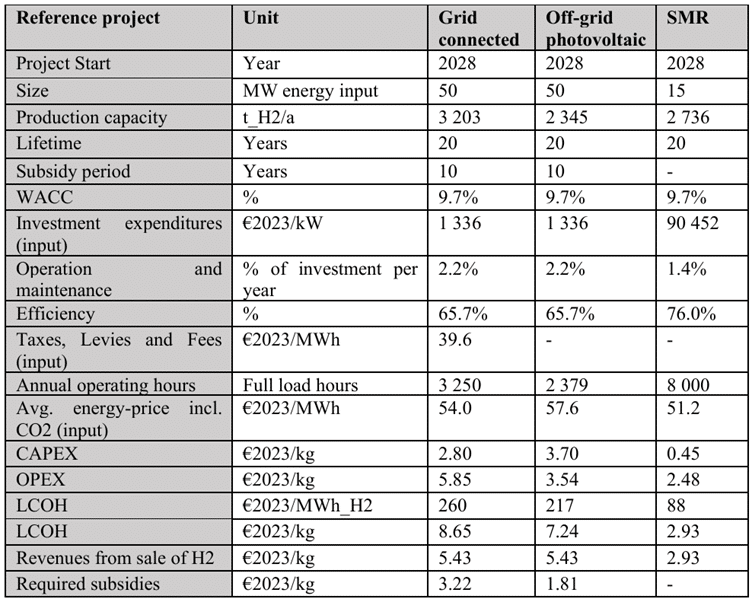
The Commission, with the help of an external consultant, determined the financial characteristics of reference projects [to prevent the granting of excessive subsidies]. The table below, reproduced from the Commission decision, shows the relevant financial features of those projects. SMR refers to “steam methane reforming” which is the more polluting alternative technology.
It is also interesting to note that since the decision was taken before the US attack on Iran, the financial projections for these projects assume a rather stable gas price and a declining cost of electricity, despite a significant increase in the emission costs of CO2.
Compatibility assessment
Since Spain did not contest that the measure involved state aid, the Commission quickly proceeded to assess its compatibility with the internal market on the basis of the Guidelines on climate, environmental and energy state aid [CEEAG]. In particular, it assessed it under the general compatibility provisions in section 3 of CEEAG and the specific compatibility criteria in section 4.1 of CEEAG which lays down specific rules on for the production of renewable hydrogen.
In this article I summarise only the findings of the Commission with respect to the incentive effect, of the aid, the necessity of the aid, the proportionality of the aid and possible negative effects of the aid.
Incentive effect and necessity of the aid
“(127) To demonstrate the presence of an incentive effect, point 28 CEEAG provides that proving an incentive effect entails the identification of the factual scenario and the likely counterfactual scenario in the absence of aid to be identified. Furthermore, point 28 CEEAG requires the incentive effect of the aid to be demonstrated through a quantification for the reference projects supported under the scheme following the description in Section 3.2.1.3 CEEAG.”
“(128) In addition, point 52 CEEAG states that a counterfactual scenario may consist in the beneficiary not carrying out an activity or investment, or continuing its business without changes, and that where evidence supports that this is the case, the net extra cost may be approximated by the negative net present value of the project in the factual scenario without aid over the lifetime of the project.”
“(130) Spain provided an analysis showing that without the measure RFNBO production would not take place because the expected market revenues do not suffice to ensure viability of the projects, leading to a funding gap … Spain indeed provided a quantification referred to in point 28 and Section 3.2.1.3 CEEAG of all the costs and revenues for two reference projects that are representative of applicants to the 2025 Innovation Fund auction.”
“(144) To demonstrate the necessity of aid, points 38 and 90 CEEAG explain that the Member State must show that the reference project(s) would not be carried out without the aid, taking into account the counterfactual situation, as well as relevant costs and revenues including those linked to the EU ETS and related policies and measures”.
Proportionality of the aid
“(173) Point 103 CEEAG specifies that aid for reducing GHG emissions should in general be granted through a competitive bidding process to ensure that the objectives of the scheme can be attained in a proportionate manner which minimises distortions of competition and trade.”
“(174) Point 49 CEEAG states that when the aid amounts are determined through a competitive bidding process, the result of that process will provide a reliable estimate of the minimum aid required so that detailed assessments of the net extra costs necessary for carrying out the investment will not be required. It further provides the criteria that must be fulfilled so that the aid is deemed proportionate:
- the bidding process is open, clear, transparent and non-discriminatory, based on objective criteria, defined ex ante in accordance with the objective of the scheme and minimising the risk of strategic bidding;
- the criteria are published sufficiently far in advance of the deadline for submitting applications to enable effective competition;
- the budget or volume related to the bidding process is a binding constraint in that it can be expected that not all bidders will receive aid, the expected number of bidders is sufficient to ensure effective competition, and the design of undersubscribed bidding processes during the implementation of a scheme is corrected to restore effective competition in the subsequent bidding processes or, failing that, as soon as appropriate;
- and ex post adjustments to the bidding process outcome are avoided as they may undermine the efficiency of the process’s outcome.”
“(181) In the present case, the ranking criterion will be the subsidy price in EUR per kilo of RFNBO hydrogen produced that is submitted for the competitive bidding process … This ranking criterion directly reflects the environmental benefits the scheme aims to achieve, as displacing (products made using) fossil-based hydrogen with (products made using) the RFNBO hydrogen produced under the scheme will reduce GHG emissions.”
No undue negative effects
“(194) In the present case, the subsidy per tonne of CO2 equivalent is estimated for each reference project … The Commission has assessed the calculations. The assumptions and methodology for this estimate are based on the Commission’s own benchmark values”.
“(196) Point 116 CEEAG explains that the aid must not merely displace the emissions from one sector to another and must deliver overall GHG emissions reductions. Point 121 CEEAG explains that aid which covers costs mostly linked to operation rather than investment should only be used where the Member State demonstrates that this results in more environmentally friendly operating decisions. Furthermore, points 127 to 129 CEEAG require Member States to explain how they intend to avoid the risk of aid may stimulating or prolonging the consumption of fossil-based fuels and energy.”
In this case “(197) all projects will produce hydrogen that meets the criteria for RFNBOs … Under the sectoral rules for RFNBOs, the electricity used would either be from additional renewable sources, or be sourced from the grid when the emission intensity of the marginal generator is sufficiently low to avoid significantly increasing demand for fossil fuels or increasing GHG emissions. If beneficiaries also produce non-RFNBOs, operating aid will not cover the costs of this production, and the GHG emissions savings of these must be at least 70% on average over the subsidy period … The projects would thus not prolong the consumption of fossil-based fuels, nor lead to a mere sectoral displacement of emissions. Although a significant share of the aid will cover OPEX [see table above], the aforementioned safeguards help ensure that electrolysers are operated in a manner that minimises environmental harm. Therefore, the requirements in points 116, 121, 127 to 129 CEEAG are fulfilled.”
“(204) Point 132 CEEAG states that Member States should demonstrate how the proposed measure will not lead to distortions of competition, for example, through increased market power, should the measure be expected to benefit a particularly limited number of beneficiaries.”
“(205) Spain has estimated that the scheme will support 4 to 7 projects (see recital (43)). While this number is limited, the risk of distorting competition and trade is kept to a minimum by the aid being granted through a competitive bidding process. While Spain expects the scheme to add up to 345 MW of electrolysis capacity (see recital (43)), the EU Hydrogen Strategy calls for 40 GW of renewable hydrogen electrolysers by 2030. The scheme will therefore support a small proportion of the total expected renewable hydrogen producers in the EU market. Therefore, there appear to be no risks of additional competition distortions. The requirements of point 132 CEEAG are therefore fulfilled.”
Given that the notified measure complied with all of the relevant CEEAG requirements, the Commission approved it.
Notes:
[1] See the explanatory note of the Commission at:
[2] The full text of the Commission decision can be accessed at:
https://ec.europa.eu/competition/state_aid/cases1/202613/SA_121244_98.pdf