

Executive Summary
- Competitive bidding for state aid ensures that the aid is proportional but does not eliminate the advantage it confers to the beneficiaries.
- Eligibility criteria must be objective.
- No ex post adjustment is allowed, but indexing of inflation is permitted.
Table of Contents:
- Introduction
- Eligibility
- Auctions
- Reference prices
- Form of aid
- Feed-in-tariffs
- Presence and compatibility of the state aid with the internal market
Introduction
The Commission has recently authorised a scheme [SA.115180] notified by Italy for the support of electricity production from renewable energy sources [RES] under the Clean Industrial Deal State Aid Framework [CISAF].1 The eligible plants are those that are close to “market parity”, meaning that their costs are above but close to market prices. Specifically, the scheme will support, through two-way contracts for difference [CfDs], the production of electricity from onshore wind, solar photovoltaic, hydropower, and sewage gases. However, installations with capacity below 200 kW can receive aid in the form of a feed-in-tariff [FIT] which is a more generous form of intervention available only for small plants.
The scheme aims to support a maximum of 37.15 GW of new renewable capacity in Italy. Of this capacity, 27.15 GW will be allocated through separate competitive procedures for each technology for installations with installed capacity higher than 1 MW.
The estimated budget of the scheme is EUR 23 billion in nominal terms. The annual estimated budget of the measure is EUR 1.2 billion. The scheme will be implemented until 31 December 2030.
Eligibility
The scheme is open to undertakings of all sizes producing RES electricity. The technologies that are eligible under the scheme are new installations using onshore wind, solar, hydroelectric and sewage gases. Installations for which works have already started before the submission of their aid application are not eligible.
“(19) To qualify for the scheme, installations with installed capacity higher than 1 MW must meet the following requirements:
- i) Possession of a permit to construct andoperatethe installation or, only for technologies other than PV, a positive environmental impact assessment, where applicable;
- ii) Cost estimate of the connection to the electricity grid definitively accepted and registration of the project on the[relevant]system validated by the grid operator;
iii) Compliance with Union and national environmental protection requirements necessary to comply with the principle of ‘Do No Significant Harm’ (DNSH);
- iv) Acceptance of the obligation tosubmita bid in the dispatching services market in certain circumstances;
- v) Proven financial standing.”
“(23) In addition, applicants are required to pay a provisional and a final guarantee according to the methods and timelines defined in the operating rules. The final guarantee is equal to 10% of the expected investment costs for the construction of the plant. The provisional guarantee amounts to 5% of the expected investment costs for the construction of the plant and has to be uploaded on the GSE website during the application procedure, before the ranking’s publication.”
“(26) Installations located in the territory of other Member States of the Union (or in a nearby third country with which a free trade agreement is in force) will be allowed to participate in the auction procedures, subject to the following conditions:
- i) the existence of a cooperation agreement with the Member State or the third country where the installation islocated;
- ii) the agreementestablishesa system of reciprocity and the manner in which proof of physical import of renewable electricity is provided;
iii) the installation complies with the same requirements applied to the installations in Italian territory and foreseen by the Implementing Decree.”
Auctions
The amount of aid for plants larger than 1 MW will be determined by an open, transparent and non-discriminatory competitive bidding process to be carried out at the national level, on the basis of objective criteria, defined in advance. The procedure will be design in such a way as to minimise the risks of strategic bidding and undersubscription.
In order to access the competitive procedure, applicants must comply with the pre-requisites listed above. Applicants must indicate the offered reduction in percentage terms from the reference price applicable to the project they intend to develop. For example, the reference price for wind-powered plants for 2026 is 80 EUR/MWh. Reference prices will be periodically updated in subsequent years.
Bidders will be ranked based on the offered reduction to the reference price. Bidders offering the highest reductions will be ranked higher, within the limit of the available quotas. The largest quotas are for wind and photovoltaic installations.
The purpose of the quotas is to ensure that the bidding process is competitive, so that not all bidders will receive aid. This can be visualised in Figure 1 below.
Figure 1
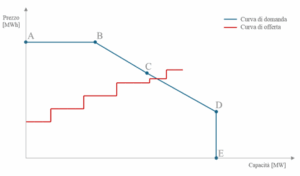
Prices are indicated on the Y axis and capacity on the X axis. Point B is the lower bound quota and upper reference price, point C is the target quota and central reference price and point D is the higher bound power quota and lower price. In other words, the Italian authorities will provide aid to bidders until cumulative capacity reaches point C. After that point, bids with higher offers [i.e. lower price reductions] will be rejected.
Reference prices
In order for state aid to be minimised, the reference prices function as a “ceiling”. Reference prices are established ex ante on the basis of estimated costs of reference projects for each technology. Not surprisingly, Table 1 below, shows that the net present value [NPV] for projects using any of the four technologies is negative and that the initial investment cost is much higher than operating cost. The NPV has been calculated using a pre-tax weighted average cost of capital [WACC] of 8%. The least loss making is solar energy, while wind energy is the most loss making. Hydroelectricity and electricity from sewage gases are the most expensive in terms of initial investment.
Table 1
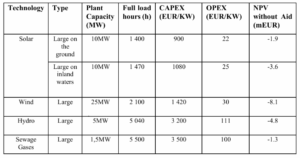
The calculations for each reference project include all main costs (investment and operating costs) and revenues. Investment costs take into account all the work necessary for the realisation of the plants, such as electrical works for the plant and for the connection to the grid, civil works, transport costs and development costs, as well as contingencies. Operating costs include all the relevant components, such as costs for raw materials, labour costs, and other operational costs (electricity, thermal energy, ordinary and extra-ordinary maintenance, insurance costs). A notable feature of RES electricity is that the operating costs are largely fixed costs for each operating period regardless of actual demand.
According to the Commission decision, “(56) the reference prices have been set in a way such that the NPV of the projects after aid is received is still close to or equal to zero, to ensure that overcompensation is avoided.”
Form of aid
The state aid will be granted as direct price support to cover the production of electricity from RES in the form of “two-way CfD”. In other words, if market price exceeds the so-called “strike price”, the beneficiaries will have to repay to the state the difference. “(61) Beneficiaries will either receive a premium covering the difference between the reference market price during the reference period and the strike price or pay back to the State this difference if it is positive.”
“(62) The strike price will be determined in the auction through a pay-as-bid system. The strike price, or awarded strike price, corresponds to the applicable upper reference tariff adjusted for the reduction offered in the auction by the selected beneficiary. For installations with capacity below 1 MW, the strike price will be set administratively by [the Italian regulator].”
“(64) Awarded strike prices will be indexed according to the Consumer Price Index to account for inflation variation between the time of publication of the call for auctions (or of the price administratively set by the Regulator … for the installations with capacity below or equal to 1MW excluded from the auctions) and the expected date of entry into operation of the installation. Awarded strike prices can also be partially adjusted to inflationary changes from the date of effective operation over the duration of the CfD”.
The duration of the two-way CfD will be of 20 years from the start of operation of each aided installation.
Interestingly, the contracts also allow for future adjustment of the remuneration of the aided installations in case they are ordered to reduce their output for reasons of operational safety of the network. However, beneficiaries will be subject to standard electricity balancing responsibilities as established by the Italian regulator.
Feed-in-tariffs
Installations with an capacity less than 200 kW can choose to receive support in the form of a feed-in tariff [FIT] rather than a two-way CfD. The FIT corresponds to the strike price and is calculated so as to result in aid intensity up to a maximum of 40% of investment costs.
Presence and compatibility of the state aid with the internal market
The most interesting aspect of the Commission’s finding that the scheme constituted state aid concerned the presence of a selective advantage, despite the fact that the beneficiaries would be selected via a competitive procedure that, normally, eliminates any abnormal advantage. However, this is not the case when the state pays undertakings to carry out projects that they would not invest in using solely their own resources.
“(97) An advantage, within the meaning of Article 107(1) TFEU, is any economic benefit, which an undertaking would not have obtained under normal market conditions, i.e. in the absence of State intervention. The scheme confers an advantage on certain electricity producers in the form of two-way CfDs or FITs for small installations … Those payments guarantee that when the electricity price is lower than the strike price, eligible electricity producers will obtain a remuneration for their electricity produced that is higher than the market price, enabling them to cover their costs, which would not be fully covered under normal market circumstances. The Commission also notes that the measure shelters the selected beneficiaries from price volatility and ensures stability of revenues. They are thus advantaged by the scheme.”
“(98) Furthermore, the aid is selective, since aid will be awarded only to certain undertakings, namely to producers of renewable electricity from specific RES … while other undertakings (RES or non-RES) in a comparable legal and factual situation are not eligible for aid and thus will not receive the same advantage.”
The compatibility of the scheme with the internal market was assessed on the basis of sections 3 and 4.1 of CISAF.
With respect to the incentive effect of state aid, the Commission noted that “(112) point 19 CISAF provides that the Commission presumes that in the absence of the aid, beneficiaries would continue their activities without changes. The Commission notes that, in the absence of the aid, the economic activity supported by the measure (i.e. deployment of RES) would not be undertaken … Therefore, the measure is presumed to have an incentive effect in line with point 19 CISAF.”
With respect to the proportionality of the aid, the Commission observed that “(129) according to point 29 of the CISAF, aid is considered to be proportionate if the amount per beneficiary is limited to the minimum necessary to carry out the project or activity benefiting from the aid, and that proportionality is generally ensured if the aid amounts are determined through a competitive bidding process, because it provides a reliable estimate of the minimum aid required by potential beneficiaries. When a competitive bidding process is used to grant the aid, point 70 CISAF establishes that the level of aid must correspond to the result of the competitive bidding and must not exceed 100% of the total eligible costs of supported projects.”
“(130) Point 53 CISAF requires aid to be granted with respect to newly installed or repowered capacities. For the latter, only the additional costs in relation to the repowered capacity should be eligible for aid. The aid is granted for newly installed or repowered capacity and Italy confirmed that, in this case, only additional costs are eligible for aid … The measure is therefore compliant with point 53 CISAF.”
“(131) Point 67 CISAF states that aid may be granted through a competitive bidding process or administratively. Point 68 provides that a competitive bidding process is required where aid is granted for the production of electricity from renewable sources with the exception of aid to demonstration projects and to small projects as defined in point 56 CISAF. In turn, point 59(a) CISAF defines projects with installed capacity equal or below 1MW as small projects. Moreover, Point 71 CISAF provides that where the aid is granted administratively, the level of aid must be set by the competent regulatory authority to cover the eligible costs.”
In paragraph 133 of the decision, the Commission pointed out that the main criteria of the competitive procedure ensured the proportionality of the aid and excluded any arbitrary discriminatory treatment of potential bidders, within the meaning of point 15(d) CISAF. The Commission identified, in particular, the following features of the procedure:
- The bidding process is open, clear, transparent, non-discriminatory.
- The eligibility criteria are clear and defined ex ante.
- At least 70% of the selection criteria for ranking bids is defined in terms of aid per unit of electricity.
- 30% of the capacity will be auctioned separately.
- The production capacity subject to the bidding process is a binding constraint.
- Not all bidders will receive aid.
- The aid amount is to be determined on the basis of the outcome of the competitive procedure.
- Ex post adjustments to the bidding outcome are excluded. [The inflation indexing is not considered to be ex post adjustment.]
The Commission found the scheme to be compatible with CISAF and therefore authorised it.