


Europäisches Beihilfenrecht Blog

State Aid Uncovered Blog

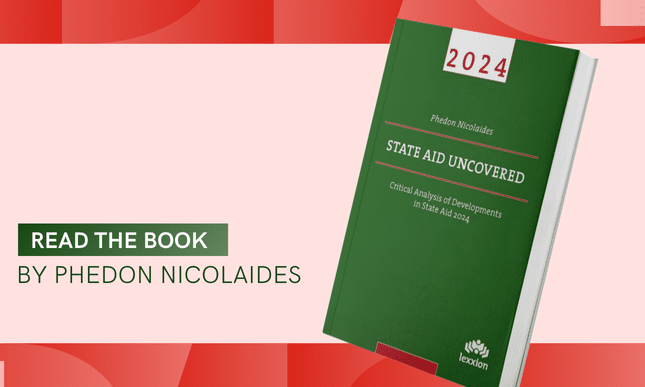
In Lexxions Blog „State Aid Uncovered” veröffentlicht Prof. Phedon Nicolaides wöchentlich kritische Analysen zu den neuesten Urteilen und Entscheidungen zu staatlichen Beihilfen. Jeder Beitrag stellt die wichtigsten Punkte eines Gerichtsurteils oder einer EU-Kommissionsentscheidung vor, ordnet sie in den Kontext ähnlicher Rechtsprechung oder Praxis ein, bewertet die zugrundeliegende Argumentation und zeigt etwaige Ungereimtheiten oder Widersprüche auf.

In loser Folge werden auf diesem Blog auch Gastbeiträge von anderen Experten für staatliche Beihilfen veröffentlicht, welche die Inhalte der Blogbeiträge ergänzen.

Jetzt abonnieren!

Professor at Maastricht University; Professor at University of Nicosia, and Academic Director at Lexxion Training

The Harm Caused by State aid and the Delineation of the Relevant Market

Introduction A competitor of an aid recipient who wants to challenge a Commission decision authorising State aid must either show that the aid harms it directly and individually – i.e. its interests are seriously affected to a larger extent than anyone else – or that the Commission should have had doubts about the compatibility of the aid during the preliminary […]

Non-imposition of Fines on Non-illegal Behaviour

Introduction Advantage is any benefit that an undertaking obtains from the intervention of the state. In some situations, however, an undertaking may derive an advantage the non-intervention of the state or, more broadly, from the failure of the state to act. This would be the case where the state does not charge a fee to a user of a state […]

When Are Decisions of State-owned Companies Imputed to the State?

Introduction According to Article 4 of Regulation 2015/1589 [the Procedural Regulation], when the Commission, after a preliminary examination of a State aid measure, has doubts as to the absence of State aid or the compatibility of the aid with the internal market, it must open the formal examination procedure. The case law says that doubts arise when the Commission encounters […]

Decarbonisation

Introduction The Netherlands intends to reduce the emission of greenhouse gasses [GHG] by 55% by the year 2050. For this reason, in June 2023 it notified to the Commission a new version of a scheme, called the “Stimulering Duurzame Energieproductie en Klimaattransitie” [SDE++] which loosely translated means incentivising sustainable production of energy and climate transition. Its purpose is to fund […]

Transition to a Net-Zero Economy

Introduction Although the TCTF requires notification of aid measures, it seems to be more user-friendly than State aid guidelines. This is because Member States may simply copy its provisions in their local law or administrative instrument and sent it to the Commission. A case in point is a German scheme that is reviewed in this article. It was notified to […]

Electricity Storage

Introduction As indicated by its title, the Temporary Crisis and Transition Framework [TCTF] allows for State aid whose purpose goes beyond the immediate relief of the costs of the market disruption caused by the Russian invasion of Ukraine. Europe’s energy policy does not only aim to reduce dependence on Russian gas, but also to shift to low or zero carbon […]

A Large Investment Project (Part II)

Introduction According to the latest edition of the State aid Scoreboard, in 2021, Member States granted EUR 14 billion of aid to support regional development. That amount corresponded to about 10% of the total non-crisis aid. What is perhaps more interesting is that close to EUR 12.5 billion or 90% of the total regional aid was granted on the basis […]

A Large Investment Project (Part I)

Introduction According to the latest edition of the State aid Scoreboard, in 2021, Member States granted EUR 14 billion of aid to support regional development. That amount corresponded to about 10% of the total non-crisis aid. What is perhaps more interesting is that close to EUR 12.5 billion or 90% of the total regional aid was granted on the basis […]

Decarbonisation of Steel Production

Introduction Many, perhaps the majority, of notifications on the basis of the Guidelines on Climate, Environmental Protection and Energy [CEEAG] concern decarbonisation of production processes. In this context, large amounts of State aid have been funnelled to the decarbonisation of steel production. ArcelorMittal has been a major beneficiary. In February 2023, Spain granted EUR 460 million to support ArcelorMittal to […]

Profitability as a Criterion of the Compatibility of State Aid with the Internal Market

Introduction When the state has a realistic prospect of making profit, its financial transactions with third parties do not constitute State aid. The absence of profit is a strong indicator of the presence of State aid but not necessarily its compatibility with the internal market. For State aid to be compatible with the internal market it must, among other things, […]

Support for the Decarbonisation of the Electricity Sector through Storage Capacity

State Aid Blogs - Untitled design 1
Introduction Romania notified a scheme to support investment in large-scale electricity storage. The Commission approved it in decision SA.102761.[1] The scheme was part of the national Recovery and Resilience Plan [RRP] of Romania and was co-financed by the EU’s Recovery and Resilience Facility. By supporting investment in electricity storage, Romania aimed to reduce carbon emissions generated by the energy sector, […]

Development of Affordable Housing

Introduction The provision of social housing can be designated as a service of general economic interest and can be publicly funded under the Commission decision 2021/21. Member States have to show that there is a real social need and limit access to social housing to those persons who cannot afford what the market provides; i.e. low-income or vulnerable persons such […]

State aid Scoreboard, 2022

Introduction On 24 April 2023, the Commission released the 2022 version of the State aid Scoreboard which this year runs to a record 226 pages.[1] It covers the State aid that was granted in 2021 and contains information on both covid-19 measures and non-pandemic aid. Covid-19 related aid reached EUR 191 billion, or 57% of total aid expenditure. Non-crisis aid […]

German Risk Finance

Introduction Relatively few risk finance measures are notified to the Commission as Member States use Articles 21 and 22 of the GBER to support investments in SMEs and start-ups. However, the GBER excludes from its scope tax incentives for investments by undertakings. Tax incentives are possible only for investments by private investors. For this reason, Germany recently notified an aid […]

Imposition of Public Service Obligations through Extension of a Concession

Introduction It has recently been confirmed in the case law that Member States are not obliged to implement a procurement procedure when they grant State aid. This means, of course, that the public funds they provide do confer an advantage on their recipient undertakings. Compliance with public procurement procedures affects the compatibility of the aid with the internal market. Indeed, […]

Update of Commission Guiding Templates on Funding by the Recovery and Resilience Facility

Introduction In December 2020, the European Commission published “templates” to help Member States in the design of their plans that were to be financed by the Recovery and Resilience Facility [RRF]. The purpose of the templates was to identify whether those plans contained State aid and, if they did, whether the aid had to be notified or not. Soon afterwards […]

Compensation for Damage Caused by COVID-19 Combined with Rescue Aid

Introduction Member States are allowed to grant state to compensate undertakings for damage they suffer as a result of a natural disaster or exceptional occurrence. But, it is not always easy or possible to disentangle the damage caused by such an unforeseen event from losses caused by mismanagement or changes of market conditions. The art and science of calculating the […]

A More Comprehensive and Generous GBER

Introduction In a Communication that was published on 9 March 2023, the Commission announced extensive amendments to the GBER.[1] A 100-page annex to the Communication provided the legal text of the draft regulation that would revise Regulation 651/2014.[2] The amendments aim to: Ensure consistency between the GBER and new State aid guidelines. Bring the GBER in line with the EU […]

Charging Infrastructure for Electric Vehicles

Introduction As part of the EU’s Green Deal and the transition to a greener and most sustainable economy, the European Commission’s guidelines on State aid for climate, environmental protection and energy [CEEAG] also allow public support for the construction of energy infrastructures. In a recent decision, the Commission approved a German State aid scheme [SA.104749] for high-power charging infrastructure for […]

State Aid for the Resolution of a Polish bank

Introduction Whenever a bank seeks State aid, it must be considered as “failing or likely to fail”. A failing bank must be liquidated or resolved. Resolution means that the critical functions of the bank are preserved while the rest are wound down. Critical functions are those that impact significantly the real economy such as deposits, loans to SMEs or payments. […]

Sie möchten einen Beitrag einreichen oder zur Weiterentwicklung des Blogs State Aid Uncovered beitragen? Weitere Details finden Sie auf der englischsprachigen Seite.

Gastbeitrag einreichen

Abonnieren Sie unseren Newsletter für aktuelle Informationen zu Entwicklungen, Konferenzen, Seminaren und Veröffentlichungen in Ihrem Interessenbereich.

Newsletter: Jetzt abonnieren