

State Aid Law Blog

State Aid Uncovered Blog

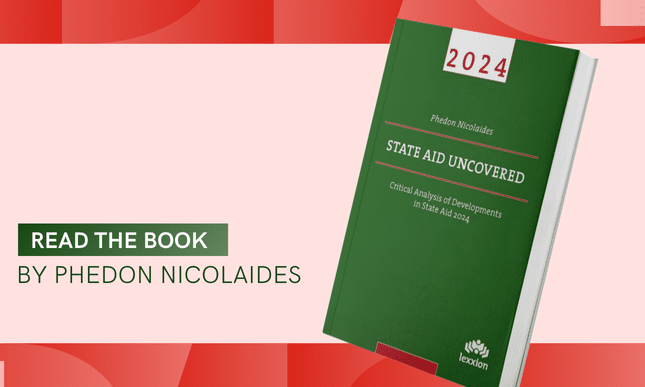
In Lexxion’s State Aid Uncovered blog, Prof. Phedon Nicolaides publishes weekly critical analyses of recent State aid judgments and decisions. Each post presents the key points of a court judgment or EU Commission decision, places it in the context of similar case law or practice, assesses the underlying reasoning and highlights any inconsistencies or contradictions.

Guest contributions from other State aid experts will also be published on the blog at irregular intervals to complement the content of the blog posts.

Subscribe now!

Danish Water Tax Exemption

A selective tax reduction does not constitute State aid if it does not confer an advantage that is proportionately larger than the magnitude of the tax reduction. A complete exemption of insignificant amounts of the taxable volume can be justified on the grounds of reducing administrative burden.     Introduction   Member States enjoy wide discretion to levy taxes on […]

The 2017 Annual Competition Report

Introduction   On 18 June 2018, the European Commission published its Annual Report on Competition Policy for 2017.[1] As usually, the Annual Report is accompanied by a Staff Working Paper that has almost four times as many pages as the Annual Report and provides more details on developments in all areas of competition policy, including State aid.The pre-eminent role of the […]

Revision of the GBER

Block exemption of new financial instruments.   Introduction   The Commission has recently published a proposal for amendment of Council Regulation 2015/1588[1] which authorises the Commission to adopt block exemption regulations. The purpose of the Commission’s proposal is to expand Article 1 of Regulation 2015/1588. This Article lists the categories of aid that may be declared compatible with the internal market.The […]

Remedying the Damage of a Natural Disaster through Incentives for New Investments

Damage from natural disasters can be remedied in the short-term through direct compensation or in the longer-term through investment subsidies to support new productive capacity.   Introduction   This article reviews a rather straightforward case which, however, is also quite unusual. It concerns a measure to remedy the effect of recent earthquakes in Italy. What makes it unusual is that […]

Sector-Specific Tax Exemptions

A measure that covers a whole sector can be selective. Distortions caused by the policies of other Member States cannot justify the granting of State aid. The purpose of State aid is not to ensure equal conditions of competition across Member States.   Introduction On 31 May 2018, the General Court ruled in case T-160/16, Groningen Seaports v European Commission.[1] Groningen […]

State Aid for the Deployment of Broadband Networks

Most State aid for the development of broadband networks is approved by the Commission. But the aid must be limited only to areas where market-based investments are unlikely to be made without aid.   Introduction   This article reviews a recent Commission decision authorising State aid for broadband development in the Netherlands which is one of the most networked countries […]

The Extent of the Discretion of Member States to Define Services of General Economic Interest (SGEI)

A service is classified as an SGEI not only when it is important for citizens but also when the market does not adequately supply it and one or more undertakings are compelled to provide it to specified consumers, in specified areas and on specified terms.   Introduction   The Treaty on the Functioning of the EU and the case law […]

Exemptions from Product-Specific Taxes

Tax exemptions do not constitute State aid when they aim to induce change in the behaviour of consumers, when they distinguish between harmful products and non-harmful products and for reasons of administrative simplicity.   Introduction   In the past two weeks, an article was published in two parts criticising the judgments of the Court of Justice in three cases of […]

Exemption from Taxes that Protect the Environment May not be Selective – Part II

Member States have discretion to impose taxes that penalise environmentally harmful activities. Exemption of undertakings whose activities do not harm the environment does not constitute State aid whenever the exempted undertakings are not in a comparable situation.   Application of Article 107(1) to the Asturias tax   In this case, exempted establishments were those with sales area less than 4000m2 or […]

Exemption from Taxes that Protect the Environment May not be Selective – Part I

Member States have discretion to impose taxes that penalise environmentally harmful activities. Exemption of undertakings whose activities do not harm the environment does not constitute State aid whenever the exempted undertakings are not in a comparable situation.   Application of Article 107(1) to the Asturias tax   In this case, exempted establishments were those with sales area less than 4000m2 or […]

The Art, Science and Law of Funding Services of General Economic Interest

The compulsory nature of an assigned public mission makes the services covered by the mission different from those provided by market operators for profit.   Introduction The justification of government intervention for the purpose of ensuring delivery of adequate services of general economic interest [SGEI] and the design of measures that compensate providers of SGEI can be very tricky. This […]

What Costs Are Charged by Public Authorities when they Act as Market Operators?

Fees charged by operators to users of infrastructure must cover all relevant costs. The relevant costs are those which are causally linked to the agreements between users and operators. Introduction The rules in the Treaty on the Functioning of the European Union are neutral in their treatment of private or state-owned companies [Article 345 TFEU]. This means that companies cannot […]

Regional Investment Aid and Sale of Land

A company that applies for State aid is considered to acquire a right to that aid when assurances it has received from the granting authority can be enforced in court. The price of land can be reduced by the cost that a new owner would expend to make the land usable.   Introduction In decision SA.40448, the Commission assessed aid […]

Bank Resolution Has to Comply with State Aid Rules as well as the Banking Recovery and Resolution Directive

Insurance funds contributed by banks become state resources if they are managed by public agencies. Sale of non-performing loans at market prices does not involve State aid.   Introduction Since 1 January 2016, the resolution financial institutions in Europe has been subject to stricter rules. The institutions which are established in the Eurozone fall with the jurisdiction of the Single […]

Identification of the Reference Tax System: The Case of a Tax on Advertising Turnover

Turnover taxes should be levied at a single rate. Introduction This is the fourth case involving turnover taxes that have been declared to be incompatible with the internal market [see Commission decision 2017/329].[1] A brief summary was published here on 13 December 2016 [http://stateaidhub.eu/blogs/stateaiduncovered/post/7697]. The reasoning of the Commission follows closely that of the other cases. However, what makes this case […]

A Postscript on Brexit and State Aid

A short note on the previous blog post on State aid control in the UK after its withdrawal from the EU.   A few weeks ago, I wrote an article on State aid control in the UK after its withdrawal from the European Union [http://stateaidhub.eu/blogs/stateaiduncovered/post/8330]. In that article I suggested that the UK would maintain the same or a similar […]

Public Support for Nature Conservation is not State Aid

A nominal price may be charged for genuine non-economic services as long as it supports the achievement of the non-economic objective and covers only a small part of total costs.   Introduction Germany notified two measures of support for nature conservation in Saxony-Anhalt. Measure 1 [SA.45645] concerned projects of nature conservation and landscape maintenance.[1] Measure 2 [SA.46073] concerned aid to associations […]

Ex Post Definition of the Method of Compensation Makes State Aid Incompatible with the Internal Market

Compliance with public service obligations imposed on a provider of services of general economic interest should not be left to the discretion of that provider.   Introduction Last week’s article examined a public service obligation for providing maritime links to Corsica (view it here: http://stateaidhub.eu/blogs/stateaiduncovered/post/8370). This week’s article reviews a similar obligation for maritime links to the neighbouring island of Sardinia. […]

The Need for Public Services Is Shown by Absence of Private Services

The scope of public service obligations must be proportional to the identified market failure.   Introduction On 1 March 2017, the General Court dismissed the application of Societe Nationale Maritime Corse Mediterranee [SNCM] against the Commission [case T-454/13, SNCM v Commission].[1] The Commission had found in decision 2013/435 that SNCM received incompatible State aid that had to be recovered. SNCM carried […]

State Aid on the Day after the Exit of the UK from the EU

The UK will “take back control” over State aid. With it will come the challenge of following EU law and practice. Introduction Last June I wrote an article on how the withdrawal of the UK from the EU could affect the application of State aid rules in the UK. The article concluded with the following prediction. “The UK will soon […]

Subscribe to our newsletter for updates on legal developments, upcoming conferences, workshops, and publications in your areas of interest.

Newsletter: Subscribe now