


Europäisches Beihilfenrecht Blog

State Aid Uncovered Blog

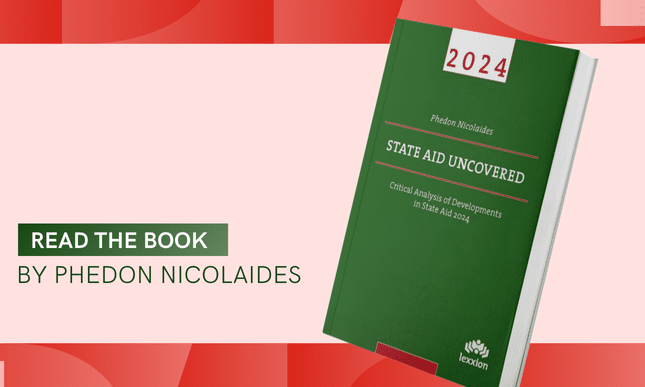
In Lexxions Blog „State Aid Uncovered” veröffentlicht Prof. Phedon Nicolaides wöchentlich kritische Analysen zu den neuesten Urteilen und Entscheidungen zu staatlichen Beihilfen. Jeder Beitrag stellt die wichtigsten Punkte eines Gerichtsurteils oder einer EU-Kommissionsentscheidung vor, ordnet sie in den Kontext ähnlicher Rechtsprechung oder Praxis ein, bewertet die zugrundeliegende Argumentation und zeigt etwaige Ungereimtheiten oder Widersprüche auf.

In loser Folge werden auf diesem Blog auch Gastbeiträge von anderen Experten für staatliche Beihilfen veröffentlicht, welche die Inhalte der Blogbeiträge ergänzen.

Jetzt abonnieren!

Professor at Maastricht University; Professor at University of Nicosia, and Academic Director at Lexxion Training

A More Comprehensive and Generous GBER

Introduction In a Communication that was published on 9 March 2023, the Commission announced extensive amendments to the GBER.[1] A 100-page annex to the Communication provided the legal text of the draft regulation that would revise Regulation 651/2014.[2] The amendments aim to: Ensure consistency between the GBER and new State aid guidelines. Bring the GBER in line with the EU […]

Charging Infrastructure for Electric Vehicles

Introduction As part of the EU’s Green Deal and the transition to a greener and most sustainable economy, the European Commission’s guidelines on State aid for climate, environmental protection and energy [CEEAG] also allow public support for the construction of energy infrastructures. In a recent decision, the Commission approved a German State aid scheme [SA.104749] for high-power charging infrastructure for […]

State Aid for the Resolution of a Polish bank

Introduction Whenever a bank seeks State aid, it must be considered as “failing or likely to fail”. A failing bank must be liquidated or resolved. Resolution means that the critical functions of the bank are preserved while the rest are wound down. Critical functions are those that impact significantly the real economy such as deposits, loans to SMEs or payments. […]

Tax Advantages and Competitive Bidding

Introduction Award of contracts or sale of state assets through competitive bidding procedures or tenders are presumed to result in a market prices and to confer no advantage to the winner in the meaning of Article 107(1) TFEU. However, on 25 January 2023, the General Court ruled, in case T-666/21, Società Navigazione Siciliana v European Commission, that certain tax advantages […]

Discretion of Public Authorities and Selectivity

Introduction On 2 February 2023, the Court of justice, in case C649/20 P, Spain and Others v European Commission, clarified the extent to which public authorities can implement general measures without in practice favouring any undertaking. The exercise of administrative discretion can turn a general measure into selective. The Court made a distinction between what may be called “related” or […]

The Selectivity and Profitability of Agreements between Airports and Airlines

Introduction Selectivity is a tricky issue. Even a measure that appears not to favour or exclude any undertaking may in practice prove to be selective if its effects favour certain undertakings over others that are in a comparable situation. In order to determine whether they are comparable it necessary to examine the objective of the measure. This is what the […]

The European Commission in not Responsible for the Bail-in of Investors in Banks

Introduction Investors in banks that failed or were restructured as a result of the financial crisis that broke out in 2008 have tried many times and have used many arguments to support their claims for compensation. None of them has so far succeeded before EU courts to prove that the Commission, or the ECB or the Council or the Eurogroup […]

State Aid May Have an Incentive Effect Even After the Start of Work: But Would it Favour Inefficient Operators?

Introduction Perhaps the most important aspect of the compatibility of State aid with the internal market is the presence of incentive effect. That is, the aid is capable of changing the behaviour of the recipient. If it does not, then public money is wasted because it has no effect on what happens on the market anyway. In principle, in order […]

Cumulation of State Aid Granted by Different Member States

Introduction The EU Green Deal and the Climate, Environmental Protection and Energy Aid Guidelines [CEEAG] allow Member States to grant more aid, in diversity and amounts, to incentivise companies to invest in greener technologies and energy. However, when multiple Member States grant aid for the same purpose, there is a risk of overcompensation of undertakings that operate across Member States. […]

State Resources Include all the Resources that Can be Directed by the State for its own Purposes

Introduction On 12 January 2023, the Court of Justice delivered its judgment in joined cases C-702/20, DOBELES HES and C-17/21, Sabiedrisko pakalpojumu regulēšanas komisija.[1] A Latvian court requested the Court of Justice to provide a preliminary ruling on the interpretation of Article 107(1) TFEU, Article 108(3) TFEU, Regulation 1407/2013 on de minimis aid and of the procedural Regulation 2015/1589. The […]

Why Grant a Loan to an Undertaking in Difficulty?

When a market operator invests in an undertaking in difficulty it also considers the possibility of restructuring, sale or closure. Introduction The answer to the question posed in the title of this article is “because the loan enables the undertaking to become viable again and repay the loan with interest”. It is now well established in the case law that […]

Individual Aid to Counter the Effects of Serious Economic Disturbance Is Legally Possible, but Is it Appropriate?

Individual aid need not be capable itself to remedy serious economic disturbance in the economy of a Member State. It is sufficient that it contributes to that effect. Introduction On 22 June 2022, in case T‑657/20, Ryanair v European Commission, the General Court confirmed once more that Member States have a right to grant State aid to the undertakings of […]

The Date on which State Aid is Deemed to be Granted Is not necessarily the Date on which the Actual Benefit Materialises

State aid is deemed to be granted even if the benefit cannot be quantified in advance and even if state resources are transferred at a future point in time. Introduction The precise date on which State aid is granted can be important such as, for example, when calculating the present value of aid granted in tranches at different points in […]

Territoriality and the Tax Treatment of Intra-group Transactions

A special tax rule can constitute the reference or normal system of taxation if it is “severable” from other tax rules and has its own legal logic. Introduction The application of State aid rules to the tax treatment of transactions between companies that belong to the same multinational group is contentious. During the past three years or so, the Commission […]

A Rare Commission Decision on SGEI Interpreting Decision 2012/21

A non-profit provider of free services which are in competition with similar services on the market is an undertaking. Introduction The decentralisation of State aid policy of the past decade has made it easier for the Member States to achieve their public policy objectives. By using blog exemption regulations and decisions, they can grant State aid faster, without having to […]

State Aid and Anti-Competitive Practices

State aid to undertakings that engage in anti-competitive practices is incompatible with the internal market. Introduction For State aid to be compatible with the internal market, it may not infringe any other provision of the Treaty or secondary legislation. Occasionally, the Commission finds State aid measures to be incompatible with the internal market because they contain clauses that exclude foreign […]

Another Case of Rescue Aid to an Airline

An undertaking does not have to be nationally “important” in order to qualify for rescue aid. Introduction The pandemic has been hard on airlines. For some of them, however, the pandemic simply exacerbated their already existing problems. On 18 May 2022, in case T‑577/20, Ryanair v European Commission, the General Court had to examine the case of State aid to […]

Risk Finance

Risk finance aid in the form of tax relief based on the GBER must be limited to private investors. Introduction Decisions of the European Commission authorising aid for risk finance are very rare. This is the consequence of the success of the Commission to get Member States to use almost exclusively the General Block Exemption Regulation [GBER] for the design […]

The Standard of Proof in State Aid Complaints and the “Informational Disadvantage” of Complainants

The Commission must use its investigative powers to seek clarification from Member States in order for it to establish whether a measure constitutes State aid, or is compatible aid, or is existing aid. Introduction Complaints are an important source of information to the Commission. The possibility afforded to undertakings to lodge such complaints with the Commission is intended to dissuade […]

Member States Must Recover of their Own Initiative Illegally Granted Aid

Aid granted illegal must be recovered by the granting authority without any need for a prior Commission decision ordering recovery. The amount of recovered aid may be limited to that which is in excess of what is allowed by the GBER. Introduction It is a well-established principle in the case law that a “prudent market operator” is responsible to check […]

Sie möchten einen Beitrag einreichen oder zur Weiterentwicklung des Blogs State Aid Uncovered beitragen? Weitere Details finden Sie auf der englischsprachigen Seite.

Gastbeitrag einreichen

Abonnieren Sie unseren Newsletter für aktuelle Informationen zu Entwicklungen, Konferenzen, Seminaren und Veröffentlichungen in Ihrem Interessenbereich.

Newsletter: Jetzt abonnieren