


Europäisches Beihilfenrecht Blog

State Aid Uncovered Blog

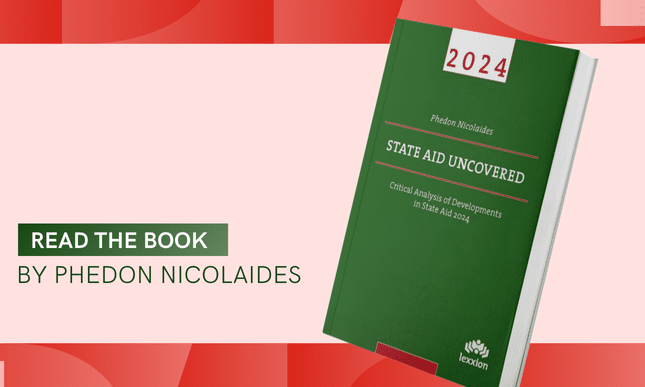
In Lexxions Blog „State Aid Uncovered” veröffentlicht Prof. Phedon Nicolaides wöchentlich kritische Analysen zu den neuesten Urteilen und Entscheidungen zu staatlichen Beihilfen. Jeder Beitrag stellt die wichtigsten Punkte eines Gerichtsurteils oder einer EU-Kommissionsentscheidung vor, ordnet sie in den Kontext ähnlicher Rechtsprechung oder Praxis ein, bewertet die zugrundeliegende Argumentation und zeigt etwaige Ungereimtheiten oder Widersprüche auf.

In loser Folge werden auf diesem Blog auch Gastbeiträge von anderen Experten für staatliche Beihilfen veröffentlicht, welche die Inhalte der Blogbeiträge ergänzen.

Jetzt abonnieren!

Professor at Maastricht University; Professor at University of Nicosia, and Academic Director at Lexxion Training

Special Economic Zones

State Aid Blogs - State Aid Uncovered SM posts 29
Member States must check that the State aid claimed by undertakings established in special economic zones concern activities that are actually carried out within those zones. Introduction Several Member States have special economic zones in which companies enjoy preferential tax treatment. These zones can be divided into two categories: those that can be found mostly in the new Member States […]

Support for Research & Innovation in the Context of the Temporary Framework

State Aid Blogs - State Aid Uncovered SM posts 21
Introduction The Temporary Framework [TF] that was introduced in March 2020 expired on 30 June 2022. However, two provisions of the TF remain in force until 31 December 2022. They are investment support for sustainable recovery [section 3.13 of the TF] and solvency support [section 3.14 of the TF]. In the former case, individual aid must be granted before 1 […]

Compensation for the Net Cost of Public Service Obligations (Part II)

State Aid Blogs - State Aid Uncovered SM posts 18 1
Public service obligations must be imposed through an act of entrustment that defines clearly the terms of the service and the duration of the obligation. The “reasonable profit” in the public service compensation should reflect the risk borne by the provider. Introduction In 2009, the Commission received several complaints concerning State aid that Italy had granted to the various shipping […]

Compensation for the Net Cost of Public Service Obligations (Part I)

State Aid Blogs - State Aid Uncovered SM posts 19
Public service obligations must be imposed through an act of entrustment that defines clearly the terms of the service and the duration of the obligation. The “reasonable profit” in the public service compensation should reflect the risk borne by the provider. Introduction In 2009, the Commission received several complaints concerning State aid that Italy had granted to the various shipping […]

Legal Standing of Competitors

State Aid Blogs - State Aid Uncovered SM posts 18
A Commission decision authorising or prohibiting a state aid measure that can be implemented without any intermediate rules is a “regulatory act” that can be challenged by “directly concerned” undertakings. Introduction Any natural or legal person who is the addressee of an act of an EU institution can challenge that act before EU courts. This is a right that is […]

Economic Activities of a Research Organisation (Part II)

Introduction Member States use extensively the GBER to support R&D schemes. If we exclude the measures that were implemented in the context of covid-19 and now those which are financed by the recovery and resilience fund, not more than a dozen measures have been notified to the Commission for prior approval since 2014. Therefore, it was rather unusual that in […]

Economic Activities of a Research Organisation (Part I)

The revenue from the economic activities of a research organisation must cover the full cost of those activities. Introduction Member States use extensively the GBER to support R&D schemes. If we exclude the measures that were implemented in the context of covid-19 and now those which are financed by the recovery and resilience fund, not more than a dozen measures […]

The State Behaving Like a Private Land Owner

A private land owner changes rent at market rates. But it may accept lower rent if the user of the land incurs costs to improve it. Comparative analysis to determine the market value of land must take into account not only the particularities of the various land plots, but also the particularities of the various rental contracts. Introduction When the […]

State Guarantees without State Aid

Introduction State guarantees may constitute State aid if they are not priced at market rates. A properly priced guarantee reflects the risk assumed by the public authority that issues it and the collateral, if any, that the beneficiary undertaking can pledge. The State aid that is embedded in a guarantee that is priced below the relevant market rate is operating […]

Why Grant a Loan to an Undertaking in Difficulty?

When a market operator invests in an undertaking in difficulty it also considers the possibility of restructuring, sale or closure. Introduction The answer to the question posed in the title of this article is “because the loan enables the undertaking to become viable again and repay the loan with interest”. It is now well established in the case law that […]

The Mysterious “Substantial” Competitive Effect

State aid has a “substantial” effect on competitors when it has a direct and negative impact on their market positions that goes beyond the typical influence of aid on competitive relationships. Introduction State aid always harms competition and competitors. A public measure that has no effect on competition is not State aid. Therefore, it is not enough for a company […]

I. The Commission Need not Always Open the Formal Investigation Procedure before Correcting a Faulty Decision II. Fines for Failure to Recover Incompatible Aid

The formal investigation procedure need not be re-opened when the fault lies in the legal assessment of the measure in question. Incompatible State aid has to be recovered quickly and effectively, even from insolvent undertakings. Introduction This article examines two recent judgments concerning Greece. The first judgment explains when the Commission does not have to re-open the formal investigation procedure […]

Duplication of Infrastructure Does not Promote Regional Development

A private investor is not interested in regional development. A private investor recoups its investment in infrastructure from revenue from the operation of that infrastructure. Duplication of infrastructure does not contribute to regional development. Introduction In 2015 the European Commission caused a buzz in the State aid community when it decided that investment aid granted to a small Polish airport […]

A Non-Selective Financial Tax with a Narrow Scope

The scope of a tax must be objectively defined in order for those excluded from the tax not to benefit from a selective advantage. Introduction Taxes are burdens, so they fall outside the scope of Article 107(1) TFEU which prohibits selective benefits funded with state resources. Normally, Article 107(1) applies to benefits from tax exemptions or tax derogations which result […]

Private Creditor and the Ability of the Debtor to Repay

There are no rules as to the promptness with which a private creditor must act in order to enforce its claims. However, a hypothetical private creditor need not demand that a debtor be declared insolvent as soon as it fails, without taking any account of its longer-term potential. Introduction When the state accepts to restructure debt owed to it or […]

Public Funding of an Energy Infrastructure Project

State aid up to 100% of the funding gap of a project can be compatible with the internal market. Introduction The European Commission approved investment aid for a Liquefied Natural Gas [LNG] terminal in Alexandroupolis in northern Greece [case SA.55526]. The project involves the following: A Floating Storage Regasification Unit [FSRU] for the storage and regasification of LNG. The construction […]

Illegal Aid Cannot be Regularised a Posteriori

A Commission decision finding non-notified aid to be compatible with the internal market cannot remedy the illegality that existed before the Commission decision. Introduction In November 2021, the General Court rejected an appeal by the recipient of illegal aid who had asked the Commission to declare the aid compatible with the internal market even though the Member State concerned had […]

How to Determine Selectivity

A measure is selective when it excludes undertakings that are equally capable of contributing to the achievement of its objectives. Introduction Since no two undertakings are exactly the same, how can it be determined whether they are in a comparable situation? Differences in their features such as size or the type of technology they use do not necessarily mean that […]

First Case of a “Private Debtor” Test?

A public authority acting as a “private debtor” tries to minimise the amount that it has to pay. Introduction In assessing whether commercial transactions between public authorities and undertakings are free of State aid, the European Commission and EU courts apply the market economy investor principle [MEIP]. In essence, this principle tests whether a public investor behaves like a private […]

An Unusual Case of a “Self Notification” of State Aid by an Aid Beneficiary

Aid beneficiaries may not “notify” State aid to the Commission. Only Member States may notify aid. Beneficiaries of non-notified aid may ask national courts to penalise the granting authorities. Introduction What should an undertaking do when it finds out that a public measure from which it has been benefitting contains State aid that has not been notified to the European […]

Sie möchten einen Beitrag einreichen oder zur Weiterentwicklung des Blogs State Aid Uncovered beitragen? Weitere Details finden Sie auf der englischsprachigen Seite.

Gastbeitrag einreichen

Abonnieren Sie unseren Newsletter für aktuelle Informationen zu Entwicklungen, Konferenzen, Seminaren und Veröffentlichungen in Ihrem Interessenbereich.

Newsletter: Jetzt abonnieren