

State Aid Law Blog

State Aid Uncovered Blog

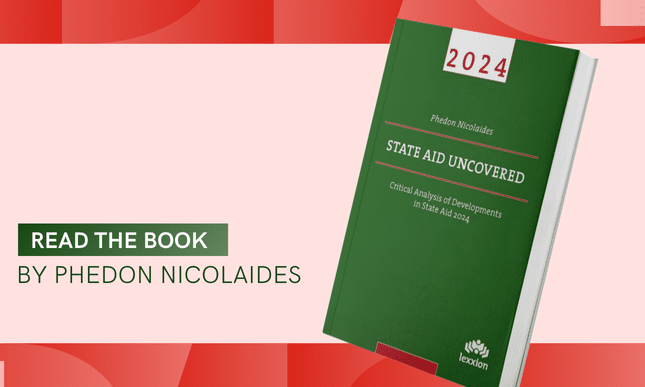
In Lexxion’s State Aid Uncovered blog, Prof. Phedon Nicolaides publishes weekly critical analyses of recent State aid judgments and decisions. Each post presents the key points of a court judgment or EU Commission decision, places it in the context of similar case law or practice, assesses the underlying reasoning and highlights any inconsistencies or contradictions.

Guest contributions from other State aid experts will also be published on the blog at irregular intervals to complement the content of the blog posts.

Subscribe now!

Infrastructure Projects, State Guarantees and Distortion of Competition

State guarantees must be limited in duration and amount and the conditions for their mobilization must be defined in advance. Public funding to an operator in a closed sector does not affect trade and, therefore, does not constitute State aid.   Introduction Large infrastructure projects are complex, encounter many unforeseen problems and often fall behind schedule for years. Consider, for […]

The Date and Scope of Public Service Compensation

Aid is deemed to be granted on the date the beneficiary undertaking acquires the legal right to it, regardless of whether it is actually paid on that date. It is not enough for a public authority to define the service that it wants an operator to provide and the price that it should charge. It must also define where and […]

The Challenge of Identifying the Reference Tax System: The Spanish Goodwill Case, Again

To determine whether an aid measure is selective, the treatment of the beneficiaries has to be compared to those undertakings which are in a comparable position.   Introduction   On 15 November 2018, the General Court ruled in case T-239/11, Sigma Alimentos Exterior v European Commission.1 Sigma Alimentos Exterior (SAE), a Spanish company, appealed against Commission decision 2011/282 which found that […]

The Recovery of Incompatible Aid Cannot be Absolutely Impossible Unless it is first Attempted

Introduction In its ruling of 6 November 2018 in cases C‑622/16 P to C‑624/16 P, Scuola Elementare Maria Montessori v European Commission, the Court of Justice made it harder for Member States to escape from their recovery obligations.[1] Montessori appealed against the judgment of the General Court in case T‑220/13, Scuola Elementare Maria Montessori v European Commission. That judgment was reviewed here on […]

Legal Standing of Investors in Failed Banks

Investors that lodge claims before national courts for damages from resolution of banks have legal standing to request annulment of Commission decisions authorising State aid to those banks. Introduction It is now ten years since the start of the financial crisis. In these ten years, the Commission has adopted about 500 decisions dealing with State aid to banks and other […]

State Aid Provisions in the Draft Agreement on the Withdrawal of the UK from the EU

The agreement on the withdrawal of the UK from the EU requires compliance with EU State aid rules.   Introduction   On 14 November 2018, EU and UK negotiators finalised the text of the Agreement on the withdrawal of the UK from the EU.[1] The Agreement has to be ratified by the UK and the other 27 Member States. Given immediate […]

Using the Correct Methodology to Calculate Public Service Compensation

Compensation for the extra costs of a public service obligation may include a reasonable profit that reflects the risk borne by the provider of the public service.   Introduction   The calculation of the amount of compensation for the extra costs of public service obligations can be difficult and tricky. In the absence of such calculation, aid to providers of […]

Unconditional and Unlimited Guarantees and their (In)Compatibility with the Internal Market

Operating aid is not normally compatible with the internal market. Therefore, State aid provided through state guarantees should not cover operating costs. State aid embedded in guarantees must be quantifiable so that its necessity and proportionality can be assessed. The assessment of State aid must be made within an EU context taking into account its impact on trade.   Introduction […]

Tax Inseparably Linked to State Aid

Taxes which are inseparably linked with an aid measure are assessed together with the aid itself.  An increase of the budget of an aid scheme by more than 20% constitutes a change of existing aid that must be notified to the Commission for prior authorisation.   Introduction Taxpayers may not refuse to pay taxes on the grounds that the tax […]

Public Service Obligations Must be Properly Defined and Selectivity Must be Proven [1]

Neither the existence of market failure, nor national laws that designate a service to be in the general interest can replace an official act that assigns to one or more undertakings clearly defined public service obligations.   Introduction The proper definition of public service obligations (PSOs) is an issue that arises with surprising regularity. It is surprising because numerous court […]

What Happens when Things Go Wrong

Only EU institutions can provide assurances that aid is granted legally. The amount of State aid in a state guarantee given to a company in difficulty can be equal to the amount of the guaranteed loan. The simultaneity of public and private investments is not enough to ensure that the public investment is at market terms. They must also be […]

Investment in Airport Infrastructure

Public funding of infrastructure used for non-economic purposes does not constitute State aid. Public investment in infrastructure used for economic purposes does not constitute State aid if the investment can generate a return that is acceptable to a private investor.   Introduction   On 25 January 2018, the General Court ruled in case T-818/14, Brussels South Charleroi Airport v Commission.[1] Brussels […]

How a Private Investor Behaves: EDF v Commission

A private investor carries out an assessment of the prospective profitability of a company before it invests in it. Ex post assessment is not sufficient. Evidence that the investment is likely to be profitable is not enough. The return must be high enough to satisfy a private investor in a similar situation (by compensating it for the risk it assumes). […]

The Puzzle of the State Acting as a Regulator

When the state exercises its regulatory tasks, it does not have to demand fees and therefore it does not forgo potential state resources.   Introduction A few weeks ago the Commission considered whether the regulatory actions of the state fell within the scope of Article 107(1) TFEU. In decision SA.42028 concerning aid to Yliopiston Apteekki Oy in Finland, the Commission […]

Danish Horse Racing

Taxes hypothecated to State aid measures fall within the scope of the assessment of the compatibility of those measures.   Introduction Operating aid is not normally allowed. Yet, in decision SA.48604 concerning horse-racing betting in Denmark the Commission appears to have authorised operating aid.[1] This measure was approved within six months. In the post-SAM, it must be one of the […]

Selectivity Requires Comparison

To determine whether a measure is selective it is necessary to compare the beneficiary companies to other companies which are in a similar situation and determine whether the latter receive the same advantage. Introduction[1]   On 20 December 2017, the Court of Justice delivered three judgments in appeals against rulings of the General Court concerning the expansion of digital terrestrial television […]

Structural Disadvantages and Regional Aid

Aid that seeks to neutralise a structural disadvantage still confers an advantage. Aid that seeks to remedy market failure is selective. State aid that is compatible with the internal market must be necessary to achieve an objective of the Treaty and be capable of incentivising a change in the behaviour of the recipient undertakings.   Introduction On 13 December 2017, […]

PART II: Concessions and State Aid: Does the State Act as a Regulator or Market Operator?

When Member States act as regulators they need not maximise revenue from the granting of concessions rights. When Member States act as regulators they must grant concession rights on the basis of procedures which are competitive, transparent, non-discriminatory and unconditional.   Part II: Public procurement principles[1] Principles for selection of concession holders The Commission examined also, in addition to the […]

PART I: Concessions and State Aid: Does the State Act as a Regulator or Market Operator?

When Member States act as regulators they need not maximise revenue from the granting of concessions rights. When Member States act as regulators they must grant concession rights on the basis of procedures which are competitive, transparent, non-discriminatory and unconditional. Introduction   Is it possible for a public authority to grant State aid through a defective procurement procedure? The answer […]

Top 5 State Aid Uncovered Posts in 2017

Questions around grants for R&D&I projects, economic activities of religious establishments or concession agreements besides many more, have moved and shaped this year’s judgments on State aid. Also Brexit and its meaning for State aid control in the UK has been on everyone’s mind. See which articles by Prof. Phedon Nicolaides were the most popular ones in 2017. We have […]

Subscribe to our newsletter for updates on legal developments, upcoming conferences, workshops, and publications in your areas of interest.

Newsletter: Subscribe now