

State Aid Law Blog

State Aid Uncovered Blog

In Lexxion’s State Aid Uncovered blog, Prof. Phedon Nicolaides publishes weekly critical analyses of recent State aid judgments and decisions. Each post presents the key points of a court judgment or EU Commission decision, places it in the context of similar case law or practice, assesses the underlying reasoning and highlights any inconsistencies or contradictions.

Guest contributions from other State aid experts will also be published on the blog at irregular intervals to complement the content of the blog posts.

Subscribe now!

Remarks on the Infrastructure Section of the Commission Notice on the Notion of State Aid

Today we are glad to welcome once again Gian Marco Galletti as guest author on our State aid blog. He is a PhD Candidate & EU Law Tutor at the Dickson Poon School of Law of King’s College London. In this blog post he comments on the Commission’s new Notice on the notion of State aid. Thank you for your […]

New Video: Why Should Public Authorities Be Concerned About State Aid?

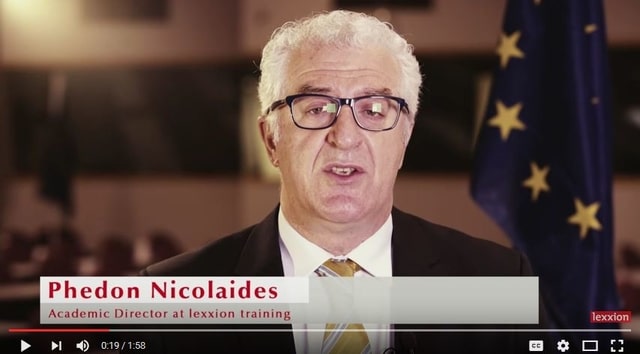
What is State aid? Why do I need to be concerned about State aid? These and many more basic questions will be answered in our videos on YouTube. Make sure to visit us!   Today Phedon Nicolaides tells you, why public authorities should be concerned about Stateaid. Please comment and subscribe.    Visit our YouTube Channel and show all videos. You […]

Beneficiaries and Benefits of State Guarantees

A state guarantee is presumed to lower borrowing costs. However, any other benefits in relation to customers or suppliers have to be proven.   Introduction On 26 May 2016, the General Court rendered its judgment in case T-479/11, France v Commission concerning the IFP.[1] France appealed against Commission decision 2012/26 which found that France granted aid to IFP. IFP iIFP s […]

State Aid Goes YouTube: Visit Phedon Nicolaides on our YouTube Channel

What is State aid? Why do I need to be concerned about State aid? What is General Block Exemption Regulation (GBER) and how to use it? These and many more basic questions will be answered in our videos on YouTube. Make sure to visit us!   With great pleasure we announce the beginning of a new era of e-learning about […]

Sport Facilities, the Balancing Test and Distortion of Competition

Aid measures that target persons with particular needs and who are not adequately provided by the market are not likely to be found to distort competition contrary to the common interest, even if there is some substitutability between the subsidised services and similar services provided by the market on commercial terms.   Introduction In August 2011, the Commission received a […]

Frucona Revisited: Confusing EDF and Placing the Burden of Proof Where it Belongs

We are happy to welcome Erika Ellyne on the State Aid Blog today. She is a lawyer at Van Bael & Bellis law firm where she works on EU competition law matters. Previously she was a researcher at the VUB University and the LSTS research center, where she is still an affiliate. Today she gives her insights on the Frucona […]

Court’s Diary – June 2016

Find below the court’s diary for all State aid cases this month. Would you like to write a comment on one of them? Please don’t hesitate and get in touch with us ([email protected]), we are happy to publish your comment on the blog.   Thursday 09/06/2016   Judgment in Case T-162/13 – Magic Mountain Kletterhallen and Others v Commission (General […]

Support for Green Electricity: State Resources and “PreussenElektra”

Arrangements established by law whereby undertakings are compensated for any extra payments they make to producers of green electricity are likely to bring those payments under the control of the state. Those payments will then be classified as state resources regardless of whether they are managed by private entities.   Introduction On 10 May 2016, the General Court issued its […]

Tax Exemptions Authorised by the Council of the EU

State aid is an objective concept. When the Commission assesses a measure it has to examine its effects and cannot be bound by a decision of the Council. A beneficiary of State aid cannot entertain legitimate expectations simply because the Commission does not appear to object to the aid.   Introduction On 22 April 2016, the General Court rendered its judgment […]

PART II: Regional Development and i) Market Economy Operator Test ii) Services of General Economic Interest

A market economy operator undertakes activities whose incremental revenue exceeds their incremental costs. A market economy operator ignores costs which are unaffected by those activities. A service of general economic interest has special characteristics that set it apart from other services with positive impact on the economy. Having a positive impact is not enough.   Part II: Public tasks and […]

Restructuring Aid, Recovery of Aid and Procedural Rights

Restructuring aid can finance any part of a restructuring plan. Compensatory measures initiated before the granting of restructuring aid can be taken into account as long as they are linked to the restructuring itself. Member States have to comply with the conditions defined in Commission decisions. They cannot justify non-compliance on the grounds of domestic institutional difficulties. Regional authorities that […]

Public Service Obligations: A Few More Mistakes that Can Be Avoided

Even efficient companies will fail the 4th Altmark criterion if their costs are not proven to be comparable to those of a typical and well-equipped undertaking. Public funding of infrastructure is not State aid to users only if access is open to all. Public funding for training to raise social awareness is still State aid if it relieves companies of […]

A National Measure that Does Not Apply at Regional Level Is Not Necessarily Selective

Where there is a constitutional division of tax competences, different authorities may tax similar activities at different rates.   Introduction This article examines Commission decision SA.34469 on differential tax rates for online and land-based gambling in Spain.[1] In the Spanish political system, regions that have the status of Autonomous Communities have powers of taxation. The issue at hand was which authority […]

A Market Operator, unlike a Public Authority, Does not Have to Treat all Customers Equally

In managing infrastructure, a public authority acts as a private operator when it seeks a reasonable return on its investment and also takes into account the alternative of not operating the infrastructure. The manager of an infrastructural project may charge different fees to different users to optimise usage and increase revenue.   Introduction This article reviews Commission decision 2015/506 concerning […]

Do Free but Compulsory Tests Confer a Selective Advantage?

State aid rules apply to measures which are either harmonised at EU level or are left to the discretion of Member States. The protection of public health is no sufficient reason for removing a public measure from the scope of Article 107(1). The fact that undertakings are obliged by law to comply with certain tests does not justify the subsidisation […]

Land Development

The sale of land and buildings owned by a public authority conforms with the market economy operator principle when i) it is profitable, ii) there is no alternative transaction that is economically more attractive, and iii) the sale is as profitable as similar transactions concluded at the same time.   Introduction The article examines Commission decision 2015/507 concerning the sale […]

PART II: Green Electricity and Reduction of Energy Taxes for Energy-Intensive Users

Part II: Support of electricity production from renewable energy sources is normally compatible with the internal market. Reduction of taxes on electricity used by energy-intensive industries is allowed only for certain sectors exposed to international trade and only when they bear a certain cost. Taxes on imported electricity normally infringe free-trade and non-discrimination provisions, unless commensurate benefits are extended to […]

Green Electricity and Reduction of Energy Taxes for Energy-Intensive Users

Support of electricity production from renewable energy sources is normally compatible with the internal market. Reduction of taxes on electricity used by energy-intensive industries is allowed only for certain sectors exposed to international trade and only when they bear a certain cost. Taxes on imported electricity normally infringe free-trade and non-discrimination provisions, unless commensurate benefits are extended to imported electricity. […]

State Guarantees

The amount of State aid in a guarantee that makes possible the granting of a loan to a well-collateralised firm in difficulty is not the difference in premium but the difference in interest rates. Beneficiaries of guarantees not notified to the Commission do not have any remedy under EU law. Introduction   Last week’s article examined State aid in the […]

Loans for SMEs

Low-interest loans may be used to support investments. The granting of de minimis aid through loans is possible only if loans are secured against collateral. The 2008 Commission Communication on interest rates does not apply to subordinated, non-collateralised loans.   Introduction “Investment for growth” is the slogan which seems to be on everybody’s lips in Brussels. Last Friday, the European […]

Subscribe to our newsletter for updates on legal developments, upcoming conferences, workshops, and publications in your areas of interest.

Newsletter: Subscribe now