

State Aid Law Blog

State Aid Uncovered Blog

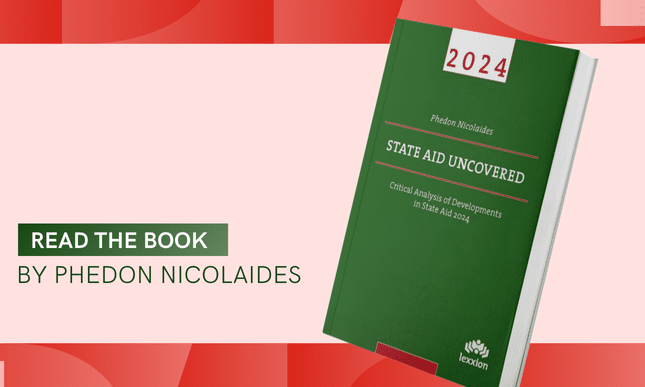
In Lexxion’s State Aid Uncovered blog, Prof. Phedon Nicolaides publishes weekly critical analyses of recent State aid judgments and decisions. Each post presents the key points of a court judgment or EU Commission decision, places it in the context of similar case law or practice, assesses the underlying reasoning and highlights any inconsistencies or contradictions.

Guest contributions from other State aid experts will also be published on the blog at irregular intervals to complement the content of the blog posts.

Subscribe now!

Economic Continuity and Recovery of Incompatible State Aid

Incompatible State aid must be recovered from “successor” companies which acquire previously aided companies and enable the latter to continue their operations without any change.     Introduction In this article I review two decisions in which the Commission determined that incompatible aid had to be recovered from “successor” companies. Those were companies which had obtained the assets of the […]

The Perennial Altmark Questions

A SGEI provider does not have to be efficient by industry standards in order to receive compensation for its next extra costs. Although the conditions for compatibility of public service compensation under Article 106(2) TFEU appear to be similar to the Altmark criteria, they have very different objectives.   Introduction Even since the Altmark judgment of July 2003, public authorities […]

A new misnomer in State aid law: single economic unit with separate legal personality (C 357/14 P, Dunamenti Erőmű/Commission)

The following blog post is a contributory piece by Emanuela Matei, Associate Researcher at the Centre of European Legal Studies, Bucharest. Matei holds a Juris Master in European Business Law (Lund University, June 2012), a Magister legum (Lund University, June 2010) and a BSc in Economics & Business Administration (Lund University, June 2009). We are very glad to welcome her […]

Should State Aid that Is Passed on to Consumers Not be Recovered?

Should the amount of recoverable aid be similarly reduced by the amount that is allegedly passed on to consumers? I will argue the case against it.   Introduction On 5 February 2015, the General Court, in cases T-473/12, Aer Lingus v Commission[1] and T-500/12, Ryanair v Commission[2], annulled Article 4 of Commission Decision 2013/199. In that decision the Commission found that a […]

A Primer on Compensation for the Extra Costs of Public Service Obligations Taking into Account Efficiency Gains

When Member States impose PSOs they are never allowed to grant even a single euro in excess of the net extra costs of the PSO. That is prohibited for the simple reason that it results in over-compensation.     Introduction The Lexxion seminar on state aid for transport and transport infrastructure that took place in Brussels on 21-22 September (view […]

Courts’s Diary – October 2015

Any comments on #Stateaid? Get in touch: Stateaidhub[at]lexxion.eu   Thursday 01/10/2015 Judgment in Case C-357/14 P – Electrabel and Dunamenti Erőmű v Commission (Court of Justice – Third Chamber)   Tuesday 06/10/2015 Judgment in Case C-303/13 P – Andersen v Commission (Court of Justice – Grand Chamber)   Thursday 08/10/2015 Hearing in Joined Cases T-479/11 & T-157/12 – France v Commission, […]

The State Acting as a Private Creditor & State Aid Enforcement and Procedural Rights

In this article I review Commission decision SA.37100 on JSC Liepajas Metalurgs [LM], once Latvia’s largest steel company and major employer. The decision examines whether Latvia acted promptly to recover a debt owed to it by a company that faced financial difficulties. The question was whether Latvia acted as a private creditor when it allowed the debtor to continue operations. […]

Airport Infrastructure, Public Remit and the MEOT

A public authority, acting as a private investor, may provide finance which is free of state aid to an airport and at the same time grant state aid to the same airport. Public funding of activities that fall within the exclusive tasks of the state is not state aid. When a public authority defines the activities that fall within the […]

New State Aid Regulations

Regulation 2015/1589 is the new procedural regulation. It lays down the rules for, among other things, notification of state aid, formal investigation, injunctions and recovery of incompatible aid. Because of its importance in the EU system of state aid control, it will be fully reviewed at a forthcoming article. In the Official Journal of 24 September 2015 you will find […]

How Reasonable The Private Investor May Be Assumed To Be? Corsica Ferries France

The following article summary is a contributory piece by Gian Marco Galletti. The full piece was published in the Common Market Law Review. Galletti is working as a researcher at the Dickson Poon School of Law since 2013. He is currently working on a PhD in European law under the supervision of Prof. Andrea Biondi. He holds an LLB with […]

The New Guidelines on State Aid for Environmental Protection and Energy, 2014-2020

The new guidelines are wider in scope: They also cover energy infrastructure, energy capacity and reductions from electricity levies. The new guidelines have higher thresholds for individual notifications. They allow higher aid intensity when aid is granted through competitive bidding. They require more rigorous application of the principles of necessity and proportionality of aid. Introduction   In 2012, the latest year for which […]

A Textbook Case of False Arguments: T-150/12, Greece v Commission

Recipients of State aid obtain an advantage even if they do not succeed to improve their position on the market. Recipients of State aid obtain an advantage whenever their competitors in intra-EU trade do not receive the same aid from the same source. Even small amounts of aid can disturb intra-EU trade where there is strong cross-border competition. The European Commission is not […]

Two Judgments: a) Unlimited State Guarantees and b) The Discretion of the Commission in Restructuring Measures

Unlimited state guarantees are never compatible with the internal market. The existence of an unlimited guarantee and its benefits can be inferred from the relevant legal context in which the state assumes certain obligations towards creditors. The Commission may impose both structural and behavioural remedies on recipients of restructuring aid These remedies may cover sectors other than the main sector in which […]

The Importance of a Correct Framing of the Private Creditor and Private Investor Tests

A public authority acting as private creditor must exhaust all legally available means of recovering money owed to it. A private creditor may agree to an amicable arrangement – depending on the complexity and duration of legal proceedings, the value of the collateral it holds and the chances of long-term viability of the debtor – if it results in repayment of […]

Guidance on the Application of Regulation 1370/2007 on Passenger Transport Services

Public service obligations may only be imposed where the market does not provide adequate services in terms of price and/or quality. The selection of service providers must respect the principles of openness, transparency and non-discrimination, even when public procurement procedures may not apply. Compensation must be based on contracts which contain a precise definition of the public service and parameters on how […]

Competitive Elements in the Selection of Operators of Sports Infrastructure May not Be Enough to Eliminate State Aid

The existence of an advantage cannot be excluded when the operator of an infrastructural facility is chosen through a competitive procedure which combines price with other selection criteria. The users of a subsidised infrastructural facility who pay a market fee may still derive an advantage when the facility is designed and/or reserved for certain usage. Introduction   Ever since the Leipzig-Halle […]

Public Funding of Projects that Encounter Financial Problems

Aid that is granted after the start of a project lacks incentive effect and is, therefore, incompatible with the internal market. However, aid may be justified when a project runs into financial trouble and, as a result, is likely to be abandoned without the aid. Introduction   In two decisions in December 2013, the European Commission authorised State aid for two […]

SMEs Linked through Natural Persons

Two or more enterprises may constitute a single undertaking when their owners and/or managers are related in a way that they can act jointly to exercise influence over the decision of those enterprises. Introduction   On 27 February 2014, the Court of Justice rendered a judgment on the notion of “linked enterprises” following a request for preliminary ruling from a […]

The New Guidelines on State Aid to Airports and Airlines: Problematic Issues (part 2)

Introduction Last week I reviewed the main provisions of the new Guidelines on State Aid to Airports and Airlines. This week I focus on three issues which are either not well explained or too ambiguous, leaving too much room for creative interpretation. [1] Investment funding gap The new Guidelines, like the other new rules, stress that aid must have an incentive […]

The New Guidelines on State Aid to Airports and Airlines (part 1)

Introduction[1] One more set of State aid rules for 2014-20 has been adopted. On Thursday, 20 February 2014, the Commission published its Guidelines on State Aid to Airports and Airlines.[2] The other main substantive rules which are already in place are the following, in chronological order:[3] The package on services of general economic interest (SGEI): A Communication, a Decision (like a […]

Subscribe to our newsletter for updates on legal developments, upcoming conferences, workshops, and publications in your areas of interest.

Newsletter: Subscribe now