


Europäisches Beihilfenrecht Blog

State Aid Uncovered Blog

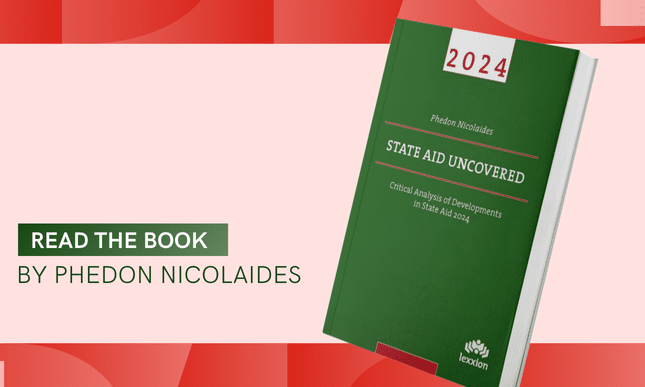
In Lexxions Blog „State Aid Uncovered” veröffentlicht Prof. Phedon Nicolaides wöchentlich kritische Analysen zu den neuesten Urteilen und Entscheidungen zu staatlichen Beihilfen. Jeder Beitrag stellt die wichtigsten Punkte eines Gerichtsurteils oder einer EU-Kommissionsentscheidung vor, ordnet sie in den Kontext ähnlicher Rechtsprechung oder Praxis ein, bewertet die zugrundeliegende Argumentation und zeigt etwaige Ungereimtheiten oder Widersprüche auf.

In loser Folge werden auf diesem Blog auch Gastbeiträge von anderen Experten für staatliche Beihilfen veröffentlicht, welche die Inhalte der Blogbeiträge ergänzen.

Jetzt abonnieren!

Professor at Maastricht University; Professor at University of Nicosia, and Academic Director at Lexxion Training

How to Calculate a Transparent Amount of State Aid in Public Guarantees

State aid granted in the form of public guarantees is transparent aid when it is calculated according to the methodology of the 2008 Commission notice or a methodology that is notified to and approved by the Commission.   Introduction Aid to farmers, small enterprises or revenue-generating projects is often given in the form of state guarantees. This is because what […]

The Scope of Public Service Obligations

Public service obligations may cover both profitable and unprofitable segments of the market.   Introduction 18 January 2017, the General Court delivered its judgment in case T-92/11 RENV, Jørgen Andersen, v European Commission.[1] Mr Andersen appealed against Commission Decision 2011/3 which concluded that public service contracts between the Danish Ministry of Transport and Danske Statsbaner [DSB], the incumbent train operator, contained […]

Financial Cooperatives

National courts may not question Commission decisions but they may ask the Court of Justice for guidance on how to interpret Commission decisions. Protection of shareholders of a particular category of companies is a selective measure. Introduction This is the last article dealing with the judgments that were rendered by EU courts on 21 December 2016. This article reviews the reply […]

Selectivity Stretched

Derogations that result in different tax treatment are selective measures. Introduction On 21 December 2016, the Commission achieved an important legal victory when the Court of Justice found in its favour in the judgment in joint cases C‑20/15 P and C‑21/15 P, Commission v World Duty Free Group [formerly Autogrill España] and Commission v Banco Santander, respectively.[1] The Commission appealed […]

Part II: Developments on the Concepts of Advantage and Selectivity

The advantage conferred by State aid is not necessarily equivalent to the economic benefit that is eventually enjoyed by aid recipients. Incompatible State aid has to be repaid regardless of whether it is passed on to the customers of the aid recipients. Undertakings derive an advantage when state intervention reduces the costs they would bear under “normal market conditions” whereby […]

Developments on the Concepts of Advantage and Selectivity

The advantage conferred by State aid is not necessarily equivalent to the economic benefit that is eventually enjoyed by aid recipients. Incompatible State aid has to be repaid regardless of whether it is passed on to the customers of the aid recipients. Undertakings derive an advantage when state intervention reduces the costs they would bear under “normal market conditions” whereby […]

Public Service Obligations and Award for Damages

Providers of public services must keep separate accounts. The parameters for calculating the compensation for the extra costs of public services must be determined in advance. Awards for damages do not constitute State aid. However, no damages can be awarded as a substitute for incompatible State aid.   Introduction It is often asked how compensation measures for public service obligations […]

Top 3 State Aid Blog Posts from 2016

From remarks on the Commission Notice on the Notion of State aid over to the right of access and State aid procedures, our guest bloggers on the StateAidHub have shed light on various controversial State aid judgments and developments. View now the most popular posts of 2016.   With the end of 2016, we thank not only Prof Phedon Nicolaides […]

Funding of the Spanish Public Broadcaster and Hypothecation of Taxes

Tax payers have grounds to object to a tax on the basis of Article 107(1) TFEU only when the tax is “asymmetrical” or when it is “hypothecated” to an aid measure.   Introduction On 10 November 2016, the Court of Justice ruled in case C‑449/14 P, DTS v European Commission.[1] DTS, a Spanish television company, appealed against the judgment of the General […]

5 most read articles by Phedon Nicolaides in 2016

Questions around selectivity of tax measures, the private creditor test, the new Commission Notice on the Notion of State Aid and many more have moved and shaped this year’s judgments on State aid. See which articles by Prof. Phedon Nicolaides were the most popular ones in 2016. We have also started an exciting new journey of State aid videos on […]

The Boundaries of Non-Economic Infrastructure and the Limits of the Funding Gap Method

Public funding of assets which are used exclusively by certain undertakings constitutes State aid. If the state chooses to fund certain assets or activities, then it must do so consistently in all regions and in relation to all affected undertakings.   Introduction A typical mission of the state is to provide public goods. Normally public funding of public goods is […]

Connecting Public and Private Infrastructure

Public funding of public infrastructure is not State aid. Public funding of connections between public and private infrastructure is not State aid as long as it is open to all users and no fee is charged.   Introduction Last week’s article examined the use of a port facility. This week the focus is on a related issue: investment in port […]

Possible Advantage from the Exclusive Use of Public-Funded Infrastructure

The exclusive use of a public asset or an asset funded by public money may confer an advantage in the meaning of Article 107(1) TFEU if several competitors express their interest to use the same asset.   Introduction As public authorities are becoming more aware that placing public assets at the disposal of undertakings can involve State aid, they increasingly […]

Nature Conservation as a Service of General Economic Interest

Public funding of non-economic activities does not create State aid problems when any related economic activities are clearly separated. The 2012 SGEI package can apply retroactively.   Introduction Member States of the European Union are free to designate the services they consider to be in the general economic interest. However, the wide discretion they enjoy in this respect falls under […]

Is there an Advantage when the State Pays for Compulsory Milk Tests?

Undertakings obtain an advantage when the state pays for their normal costs. Normal costs are costs which are inherent in the operations of undertakings. The costs of meeting legal obligations are normal.   Introduction The case law on advantage in the meaning of Article 107(1) TFEU says that aid confers an advantage to undertakings when they obtain a benefit that […]

Valuation of Assets Disposed by the State

The value of an asset can be determined according to different methods. The main methods examine future income or comparable transactions or stock market valuation. Agreements between sellers and buyers that contain indemnification clauses or settle past claims do not reflect the true market value of the sold asset.   Introduction 9 December 2015, the General Court rendered its judgment […]

An Exception Is Not Necessarily Selective: The Case of the Spanish Tax Lease [1]

An exception from a tax system is not selective if it is a priori open to any tax payer. Checks by tax authorities to ensure that a measure is applied correctly do not constitute exercise of administrative discretion that may render a measure de facto selective. The impact of a measure on trade and competition cannot be merely presumed just […]

Regional Aid to Car Manufacturers – Part II

This is the second part of the article that was published last week. Regional aid, like all State aid, must be necessary and proportional. Regional aid is necessary when investment in an assisted region is more costly. Regional aid is proportional when it does not exceed the amount which can make the investment sufficiently profitable or offset the cost disadvantage […]

Top 5 Most Read State Aid Uncovered Posts of the Year

Questions around Altmark, the Market Economy Investor Principle, the granting of De Minimis aid and many more have moved and shaped this year’s judgments on State aid. See which articles by Prof. Phedon Nicolaides were the most popular ones in 2015.   With the approach of the end of the third year of Prof. Nicolaides’ blog State Aid Uncovered, we […]

Regional Aid to Car Manufacturers

Regional aid, like all State aid, must be necessary and proportional. Regional aid is necessary when investment in an assisted region is more costly. Regional aid is proportional when it does not exceed the amount which can make the investment sufficiently profitable or offset the cost disadvantage of investment in an assisted region.   Introduction In July 2014, the European […]

Sie möchten einen Beitrag einreichen oder zur Weiterentwicklung des Blogs State Aid Uncovered beitragen? Weitere Details finden Sie auf der englischsprachigen Seite.

Gastbeitrag einreichen

Abonnieren Sie unseren Newsletter für aktuelle Informationen zu Entwicklungen, Konferenzen, Seminaren und Veröffentlichungen in Ihrem Interessenbereich.

Newsletter: Jetzt abonnieren