

Executive Summary:
- Projects of applied research may benefit from a higher rate of aid intensity.
- State aid may be granted only if the net present value of the project is negative.
Table of Contents:
Introduction
If the current text of the draft new General Block Exemption Regulation that will replace Regulation 651/2014 is adopted, it will allow for the first time state aid to support “applied research”. Yet, the concept of applied research is not new. The present RDI Framework already provides for higher aid intensity, under certain conditions, for applied research.
This kind of research comprises projects that combine industrial research and experimental development, without any specified minimum shares for either industrial research or experimental development. When they carry out applied research, large enterprises and SMEs may receive 10 percentage points more than the standard rate, including the SME bonus, for industrial research. That is, the higher rate is set at 60% for large enterprises, and 70% and 80% for SMEs, instead of 50%, 60% and 70%, respectively.
However, as with all notified aid, the need for a higher rate of aid must be justified on the basis of financial calculations that demonstrate that without aid, a research project would be commercially unviable. That is, its net present value would be negative. In this way, the size of the negative financial projection determines the maximum amount of aid.
Recently, the European Commission assessed a project of applied research and for which the amount of aid was determined on the basis of a funding gap analysis. The Commission approved state aid granted by Italy to CamGraPhIC to support a research project for the development of “foundry compatible graphene-based photonic devices” [see SA.115733].1 These devices are used for the manufacturing of microchips. Demand for microchips is expected to increase as a result of the wider application of artificial intelligence.
Italy argued that the project would contribute to Europe’s technological innovation and autonomy. It would also facilitate the development of highly technical skills.
CamGraPhIC is an Italian small enterprise with 21 employees. In 2024 the beneficiary’s turnover was EUR 2 147 535. The project aims to bring the technology readiness level of the beneficiary’s graphene-based photonic optical transceivers from TRL6 to TRL8 and develop a new pilot production facility in Bergamo, Italy.
Form and amount of aid
Aid will be provided in the form of a direct grant. The maximum aid amount is EUR 211 million in nominal terms, corresponding to [70%-80%]* of total eligible costs. The aid will be disbursed in instalments during 2026 to 2032 based on invoices. The discounted value of the aid [expressed 2025 prices] is EUR [140-160]* million.
* Business secret.
The total eligible R&D costs of the project are EUR 282.4 million in 2025-2031.
The beneficiary ordered equipment in January 2025. The order was placed after the aid application was submitted in December 2024, “at the beneficiary’s own risk”. “(9) Italy explained that this order was necessary due to the long lead times required to develop this type of specialised equipment.”
Funding gap
The funding gap of the project, calculated as its net present value [NPV], is (negative) EUR [150-200] million. “(39) The funding gap was calculated based on annual projections of capital expenditure, operational expenditure and revenues for the period from 2025 to 2040 (“the forecast period”). Based on these projections, earnings before interest and taxes (“EBIT”), corporate income taxes, and terminal value were derived. The beneficiary’s weighted average cost of capital (“WACC”) is used to discount the cashflows of the factual scenario.” The WACC is [10%-20%].
Breakdown of eligible costs
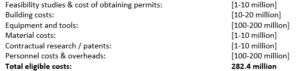
Breakdown of capital expenditure
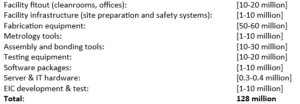
A comment is in order at this point. A research project is a temporary activity with a defined beginning and end. For assets whose economic life extend beyond the duration of the project only their depreciation is eligible cost. Therefore, it is difficult to understand how all the above costs can be considered to be eligible under R&D rules, given that they appear to have economic life beyond the end date of the research in six years’ time.
Compatibility with the internal market
Since the Italian authorities accepted that the public funding constituted state aid, the decisive issue was its compatibility with the internal market. The Commission assessed the aid in accordance with the 2022 RDI Framework.
Incentive effect
With respect to the incentive effect of aid, the Commission decision states that “(111) an incentive effect occurs where the aid changes the behaviour of an undertaking in such a way that it engages in additional activities, which it would not carry out or it would carry out in a restricted or different manner without the aid. The aid must however not subsidise the costs of an activity that an undertaking would anyhow incur and must not compensate for the normal business risk of an economic activity.”
Yet, the Commission decision is not explicit on which risks are normal and which are borne by the company as a result of the research project itself. However, the decision does explain that “(118) the project entails high commercial, financial and technological risks, related notably to the level of the innovativeness of project’s R&D activities targeting the development of graphene-based optical transceivers … In this regard, the information provided by the Italian authorities indicates that the number of companies with commercial or R&D activities concerning semiconductors based on graphene is very limited … This is in contrast to the widespread use of silicon in the semiconductor sector, where industrial standards and know-how are widely available. For the beneficiary, this lack of manufacturing know-how and standards means that most of the know-how required for manufacturing their graphene-based optical transceivers needs to be developed in-house, with important R&D risks associated with this development. … The Commission therefore considers that the innovations targeted by the beneficiary go beyond the current industrial standards and practices, and that the use of graphene, instead of the more commonly used material silicon, leads to a number of technical and commercial risks for the beneficiary, which the project aims to tackle.”
The Commission also clarifies that it “(112) considers that aid for R&D&I has no incentive effect for the beneficiary when the work on the relevant R&D&I activity has already started prior to the aid application by the beneficiary to the national authorities”. “(113) In the present case, the Commission notes that no activity took place before the aid application, which occurred on 11 December 2024”.
With respect to the counterfactual scenario, the Commission “(117) notes that the information and evidence submitted by the Italian authorities show that the beneficiary did not consider conducting a similar project absent the aid as the high, irreversible R&D costs associated to the project are not expected to be recouped by the sales of the products resulting from the project, as demonstrated by the negative NPV of the project … and the fact that positive cash flows are expected to arise only at a later stage … The Commission therefore considers that the aid has a positive impact on the beneficiary’s decision to carry out the project, which will not be implemented in the absence of aid due to its low profitability and irreversibility of the investment.”
Therefore, the Commission concluded that the aid had an incentive effect.
Need for state intervention
With respect to the need for state intervention, as required by the RDI Framework, the Commission “(130) recognises that, due to the novelty of the technology along with the lack of proven scalability, the project entails significant R&D risks, a high level of complexity … and important commercial risks … Furthermore, the Commission considers that the lack of profitability as proven by the project’s funding gap … and the time it will take for the project, ultimately, to generate positive cashflows … means that it is unlikely that the beneficiary would have been able to find sufficient private investors willing to invest in the project to a sufficient extent and under conditions that would enable to undertake the project.”
“(131) Second, the Commission notes that the beneficiary qualifies as a small enterprise … As such, access to credit is generally more difficult compared to a larger company.”
“(132) Third, the Commission considers that the semiconductors sector suffers from an important difficulty to recruit highly qualified personnel.”
In addition, the Commission refers to the positive externalities of the project.
“(134) As regards the envisaged level of knowledge dissemination, the Commission notes that the project’s results will be widely disseminated through various channels, leveraging the industrial and academic connections of the parties involved. Dissemination will occur through scientific publications, participation in international conferences, and collaboration with European and international industrial consortia and research programmes … Furthermore, the Commission notes that access to graphene photonics IP innovations will be made available to European semiconductor and photonics firms on FRAND terms”.
Proportionality
With respect to the proportionality of the aid, the Commission first recalls that “(148) in order to ensure that the level of aid is proportionate to the market failures which it is intended to address, the aid must be determined in relation to a predefined set of eligible costs and limited to a certain proportion of those eligible costs (‘aid intensity’). The aid intensity must be established for each beneficiary of aid, including in a collaboration project, and varies depending on (i) the closeness of the aid to the market; (ii) the size of the beneficiary; and (iii) the acuteness of the market failure (points 77-78 of the R&D&I Framework).”
“(149) In accordance with point 79 of the R&D&I Framework, the eligible costs for each aid measure are set out in its Annex I. When an R&D project encompasses different tasks, each eligible task must fall under the categories of fundamental research, industrial research or experimental development. As per footnote 60 of point 79, the different R&D categories can be considered to correspond to Technology Readiness Levels 1 (fundamental research), 2-4 (industrial research) and 5-8 (experimental development).”
“(150) The maximum aid intensities generally applicable to all eligible R&D&I measures are set out in Annex II of the R&D&I Framework. Concerning individual aid, however, point 92 of the R&D&I Framework clarifies that mere compliance with a set of predefined maximum aid intensities is not sufficient to ensure proportionality. As per point 93 of the R&D&I Framework, the Commission will verify that the amount of aid does not exceed the minimum necessary for the aided project to be sufficiently profitable, for example by making it possible to achieve an IRR corresponding to the sector or firm specific benchmark or hurdle rate.”
“(151) In the present case, the Commission notes that the project’s eligible costs have been identified against Annex I of the R&D&I Framework, presented in detail as part of the aid application … and supported by the most recently available documentary evidence. The Commission observes that based on the payment schedule submitted by the Italian authorities, the discounted amount of the notified aid is estimated at EUR [140-160] million, which is lower than the project NPV equal to EUR -[150-200] million … In addition, the Italian authorities confirmed that the discounted value of the aid payments will not exceed the discounted value of the funding gap, even in the case that the investments could materialise faster than currently forecasted … Since the aid is limited to the identified funding gap of the project, the Commission considers that it is limited to the minimum necessary.”
“(154) In addition, the Commission considers that the activities supported by the measure, corresponding to TRLs 6-8 …, constitute applied research in accordance with point 16(e) of the R&D&I Framework. Consequently, the maximum aid intensities allowed for individual aid measures for the category applied research (encompassing industrial research and experimental development), subject to a detailed assessment pursuant to point 93 and 94 of the R&D&I Framework, are laid down in point 95 and Annex II. For small enterprises, the maximum allowed aid intensity for applied research activities is set at 80%.”
“(155) The Commission notes that in the case at hand, the aid intensity amounts to 75% of the total eligible costs … which is lower than the maximum allowed aid intensity of 80%.”
Therefore, even though the project consists solely of experimental development and involves no industrial research, it is still classified as applied research.
Possible negative effects
With respect to possible negative effects on actual and prospective competition, the Commission devotes a large part of the decision [paragraphs 160-196] in analysing the impact of the aid on competitors and the development of the similar products. It concludes that given the size of the beneficiary and the rapid evolution of the relevant technology, competition is unlikely to be distorted to an extent that would be contrary to the common interest.
Therefore, the Commission approved the aid.