


Europäisches Beihilfenrecht Blog

State Aid Uncovered Blog

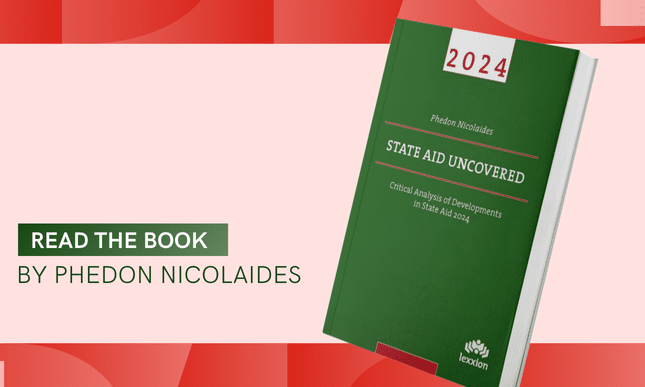
In Lexxions Blog „State Aid Uncovered” veröffentlicht Prof. Phedon Nicolaides wöchentlich kritische Analysen zu den neuesten Urteilen und Entscheidungen zu staatlichen Beihilfen. Jeder Beitrag stellt die wichtigsten Punkte eines Gerichtsurteils oder einer EU-Kommissionsentscheidung vor, ordnet sie in den Kontext ähnlicher Rechtsprechung oder Praxis ein, bewertet die zugrundeliegende Argumentation und zeigt etwaige Ungereimtheiten oder Widersprüche auf.

In loser Folge werden auf diesem Blog auch Gastbeiträge von anderen Experten für staatliche Beihilfen veröffentlicht, welche die Inhalte der Blogbeiträge ergänzen.

Jetzt abonnieren!

Professor at Maastricht University; Professor at University of Nicosia, and Academic Director at Lexxion Training

PART I: Ex Ante Assessment and Ex Post Evaluation of Risk Finance Measures

A well-designed State aid measure is preceded by a rigorous ex ante study that identifies market failure. The objectives of a well-designed measure address directly the nature and magnitude of the identified market failure.   Introduction The European Commission has approved, with decision SA.40991, amendments to two existing aid measures: Enterprise Investment Scheme [EIS] and Venture Capital Trust [VCT] in […]

Court’s Diary – March 2017

Find below the court’s diary for all State aid cases this month. Would you like to write a comment on one of them? Please don’t hesitate and get in touch with us ([email protected]), we are happy to publish your comment on the blog.   Wednesday 01/03/2017Judgment in Case T-167/14 – France v Commission (General Court – Sixth Chamber)Judgment in Case T-454/13 – SNCM v […]

State Aid for R&D: What Is Research?

Adapting know-how for the needs of clients is not research. Aid for projects for which there is no demand is not in the common interest.   Introduction The purpose of research is to discover something new. But what is often difficult to define for public authorities that wish to stimulate more research activities is how new must be the outcome […]

State Aid for R&D: How Intermediaries Pass on Aid to Third Parties

Operators of research infrastructure do not benefit from State aid, if they fully pass on the aid to the users of the infrastructure. The amount of aid must be quantified. Introduction The beneficiaries of State aid to support R&D are normally those who carry out research. However, in the case of aid to research infrastructure there may be two categories […]

How to Calculate a Transparent Amount of State Aid in Public Guarantees

State aid granted in the form of public guarantees is transparent aid when it is calculated according to the methodology of the 2008 Commission notice or a methodology that is notified to and approved by the Commission.   Introduction Aid to farmers, small enterprises or revenue-generating projects is often given in the form of state guarantees. This is because what […]

The Scope of Public Service Obligations

Public service obligations may cover both profitable and unprofitable segments of the market.   Introduction 18 January 2017, the General Court delivered its judgment in case T-92/11 RENV, Jørgen Andersen, v European Commission.[1] Mr Andersen appealed against Commission Decision 2011/3 which concluded that public service contracts between the Danish Ministry of Transport and Danske Statsbaner [DSB], the incumbent train operator, contained […]

Financial Cooperatives

National courts may not question Commission decisions but they may ask the Court of Justice for guidance on how to interpret Commission decisions. Protection of shareholders of a particular category of companies is a selective measure. Introduction This is the last article dealing with the judgments that were rendered by EU courts on 21 December 2016. This article reviews the reply […]

Selectivity Stretched

Derogations that result in different tax treatment are selective measures. Introduction On 21 December 2016, the Commission achieved an important legal victory when the Court of Justice found in its favour in the judgment in joint cases C‑20/15 P and C‑21/15 P, Commission v World Duty Free Group [formerly Autogrill España] and Commission v Banco Santander, respectively.[1] The Commission appealed […]

Part II: Developments on the Concepts of Advantage and Selectivity

The advantage conferred by State aid is not necessarily equivalent to the economic benefit that is eventually enjoyed by aid recipients. Incompatible State aid has to be repaid regardless of whether it is passed on to the customers of the aid recipients. Undertakings derive an advantage when state intervention reduces the costs they would bear under “normal market conditions” whereby […]

Developments on the Concepts of Advantage and Selectivity

The advantage conferred by State aid is not necessarily equivalent to the economic benefit that is eventually enjoyed by aid recipients. Incompatible State aid has to be repaid regardless of whether it is passed on to the customers of the aid recipients. Undertakings derive an advantage when state intervention reduces the costs they would bear under “normal market conditions” whereby […]

Regional Aid to Car Manufacturers

Regional aid, like all State aid, must be necessary and proportional. Regional aid is necessary when investment in an assisted region is more costly. Regional aid is proportional when it does not exceed the amount which can make the investment sufficiently profitable or offset the cost disadvantage of investment in an assisted region.   Introduction In July 2014, the European […]

Altmark, again!

Sectoral regulation is not the same as definition of public service obligation. Aid that favours a certain technology is incompatible with the internal market, unless it can be objectively justified.   Introduction “Altmark” has become a permanent feature in the landscape of State aid. Its application was again one of the main issues of contention in six judgments rendered by […]

i) New v Existing State Aid ii) Exemption from VAT and Attribution to Member States iii) The Duty of National Courts to Protect Competitors from Illegal State aid

Aid that pre-exists the entry of a Member State into the EU is “existing” and does not have to be recovered. VAT exemptions authorised by the EU are not State aid. National courts must disregard national legal provisions that prevent them from acting against illegal aid.   Introduction This article examines a variety of issues: when State aid is existing […]

Court’s Diary – December 2015

Find below the court’s diary for all State aid cases. Would you like to write a comment on one of them? Please don’t hesitate and get in touch with us ([email protected]), we are happy to publish your comment on the blog   Thursday 07/12/2015 Judgment in Case T-242/12 – SNCF v Commission (General Court – Seventh Chamber)   Thursday 17/12/2015 Judgment in […]

Investment and Operating Aid to Airports

State aid is granted on the date the relevant public authority makes an irrevocable commitment to grant it or creates a legal entitlement for the beneficiary. Loans that impose public policy obligations on borrowers are not in conformity with the behaviour of a private investor.   Introduction This is a rather long article because it examines a rich case that […]

Market Economy Investor Principle

Public investment is free of State aid when it is made at the same time and on equal terms with investments by private investors. In the absence of an equivalent private investment, public investment does not constitute State aid when it is demonstrated ex ante that it is capable of generating market rates of return.   Introduction Public authorities are […]

Special Tax Treatment to Alleviate Structural Disadvantages

Favourable tax treatment to alleviate “structural disadvantages” suffered by certain companies is a selective measure that falls within the scope of Article 107(1).   Introduction Member States use taxes not just to raise revenue but also as instruments of public policy. They impose taxes on activities they want to discourage [e.g. smoking, driving] and they relieve from taxes activities they […]

Sale of Public Land and Conditions for Credible Expert Valuation

The value of land corresponds to its market price that can be determined through open and unconditional bidding. If a price cannot be determined through bidding, then expert valuation is an alternative method for establishing the value of land. Expert valuation has to be carried out ex ante, by a recognised independent surveyor, on the basis of reasonable assumptions and […]

Economic Continuity and Recovery of Incompatible State Aid

Incompatible State aid must be recovered from “successor” companies which acquire previously aided companies and enable the latter to continue their operations without any change.     Introduction In this article I review two decisions in which the Commission determined that incompatible aid had to be recovered from “successor” companies. Those were companies which had obtained the assets of the […]

The Perennial Altmark Questions

A SGEI provider does not have to be efficient by industry standards in order to receive compensation for its next extra costs. Although the conditions for compatibility of public service compensation under Article 106(2) TFEU appear to be similar to the Altmark criteria, they have very different objectives.   Introduction Even since the Altmark judgment of July 2003, public authorities […]

Sie möchten einen Beitrag einreichen oder zur Weiterentwicklung des Blogs State Aid Uncovered beitragen? Weitere Details finden Sie auf der englischsprachigen Seite.

Gastbeitrag einreichen

Abonnieren Sie unseren Newsletter für aktuelle Informationen zu Entwicklungen, Konferenzen, Seminaren und Veröffentlichungen in Ihrem Interessenbereich.

Newsletter: Jetzt abonnieren