


Europäisches Beihilfenrecht Blog

State Aid Uncovered Blog

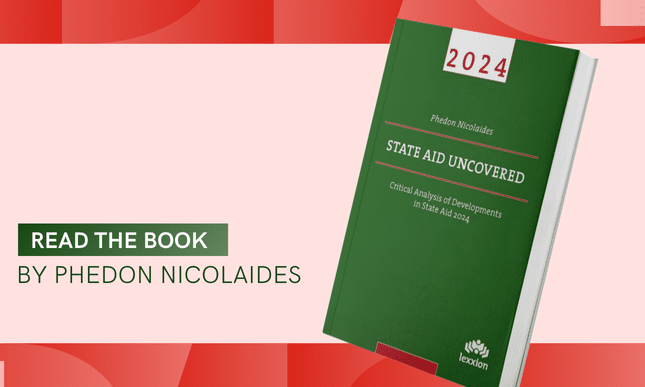
In Lexxions Blog „State Aid Uncovered” veröffentlicht Prof. Phedon Nicolaides wöchentlich kritische Analysen zu den neuesten Urteilen und Entscheidungen zu staatlichen Beihilfen. Jeder Beitrag stellt die wichtigsten Punkte eines Gerichtsurteils oder einer EU-Kommissionsentscheidung vor, ordnet sie in den Kontext ähnlicher Rechtsprechung oder Praxis ein, bewertet die zugrundeliegende Argumentation und zeigt etwaige Ungereimtheiten oder Widersprüche auf.

In loser Folge werden auf diesem Blog auch Gastbeiträge von anderen Experten für staatliche Beihilfen veröffentlicht, welche die Inhalte der Blogbeiträge ergänzen.

Jetzt abonnieren!

Professor at Maastricht University; Professor at University of Nicosia, and Academic Director at Lexxion Training

The Standard of Proof in State Aid Complaints and the “Informational Disadvantage” of Complainants

The Commission must use its investigative powers to seek clarification from Member States in order for it to establish whether a measure constitutes State aid, or is compatible aid, or is existing aid. Introduction Complaints are an important source of information to the Commission. The possibility afforded to undertakings to lodge such complaints with the Commission is intended to dissuade […]

Member States Must Recover of their Own Initiative Illegally Granted Aid

Aid granted illegal must be recovered by the granting authority without any need for a prior Commission decision ordering recovery. The amount of recovered aid may be limited to that which is in excess of what is allowed by the GBER. Introduction It is a well-established principle in the case law that a “prudent market operator” is responsible to check […]

Injection of Capital in a Postal Operator

The resources of a public undertaking necessarily count as “state resources”, regardless of the degree of autonomy of the public undertaking. However, not every decision of a public undertaking can necessarily be “imputed” to the state. A prudent investor may take into account authorised State aid. A prudent investor may tolerate short-term losses if it can realise sufficient profits in […]

A First Commission Decision on Natural Gas Storage

Compensation that guarantees a normal or fair rate of return eliminates risk that is inherent in market transactions and therefore confers an advantage in the meaning of Article 107(1) TFEU. Introduction On 23 March 2022, the European Commission announced plans to mitigate the spike in energy prices caused by the war in Ukraine. Chief among those plans were proposals for […]

Intra-State Transfers and the Discretion of Public Authorities

Resources transferred from one public authority to another for the purpose of being used to subsidise undertakings do not fall within the scope of Article 107(1) TFEU if the recipient authority has discretion in their disbursement. Introduction A public authority that carries out economic activities becomes an undertaking that is subject to the prohibition of Article 107(1) TFEU. When the […]

A New Temporary Crisis Framework

Introduction A new Temporary Framework which is called “Temporary Crisis Framework” [TCF] to distinguish it from the currently applicable Temporary Framework on covid-19 related State aid was adopted on 23 March 2022, almost two years to the date of the publication of the rules on covid-19 related State aid.[1] The purpose of the TCF is to enable Member States to […]

I. Vouchers for SMEs II. Funding of Aid with Revenue from Levies Imposed on the Aid Beneficiaries

State aid rules apply both to direct and indirect beneficiaries of aid. Introduction This week’s article reviews a Commission decision and a judgment of the Court of Justice. The Commission decision concerns Italian vouchers for SMEs to pay for the use of fast broadband services. The judgment deals with a German measure supporting milk quality tests. In both cases an […]

Another Altmark Compliant Case!

Any non-SGEI obligation attached to a public service contract may not raise the cost of the service above the level of the “least cost to the community”. Introduction It is very rare for measures of compensation for public service obligations to be found by the European Commission to be compliant with the Altmark conditions. Nonetheless, in the past two years […]

The Concept of “Undertaking in Difficulty” and Evidential Requirements

The “subscribed share capital” of a company includes the capital that is already paid and any future amount that shareholders have irrevocably committed to pay. Introduction Undertakings in difficulty may not receive any kind of aid except aid to compensate for damage caused by a natural disaster or exceptional occurrence and, under strict conditions, rescue and/or restructuring aid. In most […]

Security of Energy Supply

Guaranteed supply of electricity at fixed prices to a state-owned network operator involves a transfer of state resources to the supplier. Guaranteed supply of electricity at fixed prices confers an advantage to the supplier. Introduction Member States are allowed to take measures to ensure the security of energy supplies. There is a variety of such measures: imposition of obligations on […]

A Faulty Sale Procedure Can Lead to Presumption of State Aid and Annulment of a State Aid Decision

A sale of public assets cannot be presumed to be free of State aid when bidders are not treated equally. Introduction When the state sells a company it owns, there is a presumption that no State aid benefits either the buyer or the company that is sold if the sale is open transparent, non-discriminatory, unconditional and the chosen buyer is […]

Market Economy Operator Test: Timisoara Airport & Wizz Air

Public funding of activities that fall within the remit of the state does not constitute state aid. Although the presence of a credible ex ante business plan based on realistic assumptions is a strong indicator that the MEOT is satisfied, its absence does not necessarily prove that the MEOT is failed. Introduction Following a complaint by Carpatair, the European Commission […]

Pricing of Guarantees

A market guarantee premium must cover all costs assumed by the guarantor including the cost of possible default, cost of capital and the cost of administering the guarantee. Introduction Financial instruments are much in vogue. The Pan-European Guarantee Fund and to a smaller extent the Recovery and Resilience Fund are implemented through financial instruments that seek to leverage private participation. […]

Assignment of Public Service Obligations

The compensation for public service obligations may include reasonable profit and incentives for cost reduction. Introduction Member States have discretion to define services they consider to be in the general economic interest [SGEI]. However, they need to justify that definition. The Court of Justice has ruled on numerous occasions that an SGEI has “special characteristics” that set it apart from […]

Public Funding of an Undertaking in a Closed Sector

Public funding of undertaking in a closed sector [legal monopoly] does not distort competition and therefore does not constitute State aid. A legal monopoly has to conform with internal market rules. Introduction In July 2017, the Commission received a complaint by “C” [the complainant] alleging that Germany had granted State aid to two companies, RVV and Nordwasser, which supplied fresh […]

It is Difficult to Challenge a Commission Decision Opening the Formal Investigation Procedure

The assessment of the Commission in an “opening decision” is only provisional. The Commission is not required to prioritise its investigations or to extend them to anyone who may be in a similar situation. The right of non-discrimination is not violated when the Commission chooses to investigate some instead of all possible cases of State aid. An individual measure that […]

The Problem of Multiple Awards of Aid to the Undertaking and to the Same Group

Multiple awards of aid to the same undertaking are allowed as long as they cover different costs. Multiple awards of aid to the same group are allowed as long as aid does not leak from one undertaking in the group to another. Introduction In the first half of 2021, the General Court ruled in ten cases of appeal lodged by […]

When Do Legal Exemptions Constitute State Aid?

Exemption from a fine does not constitute State aid when it is based on transparent and pre-determined criteria. Infringement of EU law determines the compatibility of State aid, not the existence of State aid. Introduction An exemption from legal requirements that confers a selective advantage does not necessarily amount to State aid. In most cases, when beneficiaries are found not […]

Methods for Determining Property Value

Member States may use different methods for determining the value of property as long as they produce similar results. Introduction The base for property taxation is normally the value of the property, not size or location. The difficulty in determining the value of property is that land or buildings have no intrinsic value. It all depends on the purpose for […]

A Rare Commission Decision on an SGEI Measure that Could Have Been Exempted from Notification

A public service obligation must be imposed by an act of entrustment that describes in detail the terms of the obligation, identifies the undertaking that offers the service and lays down procedures for preventing over-compensation. Introduction The purpose of Commission Decision 2012/21 on services of general economic interest [SGEI] is, like the GBER, to exempt certain aid measures from prior […]

Sie möchten einen Beitrag einreichen oder zur Weiterentwicklung des Blogs State Aid Uncovered beitragen? Weitere Details finden Sie auf der englischsprachigen Seite.

Gastbeitrag einreichen

Abonnieren Sie unseren Newsletter für aktuelle Informationen zu Entwicklungen, Konferenzen, Seminaren und Veröffentlichungen in Ihrem Interessenbereich.

Newsletter: Jetzt abonnieren