


Europäisches Beihilfenrecht Blog

State Aid Uncovered Blog

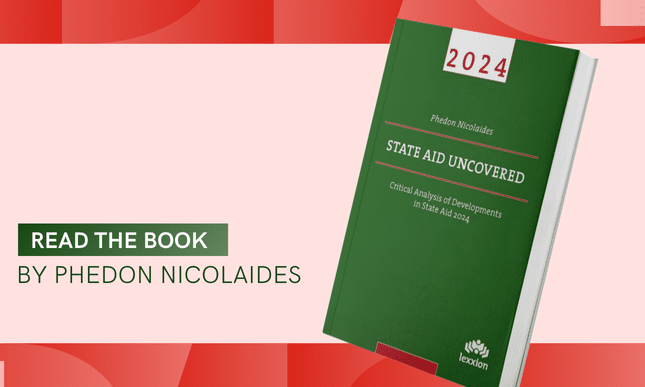
In Lexxions Blog „State Aid Uncovered” veröffentlicht Prof. Phedon Nicolaides wöchentlich kritische Analysen zu den neuesten Urteilen und Entscheidungen zu staatlichen Beihilfen. Jeder Beitrag stellt die wichtigsten Punkte eines Gerichtsurteils oder einer EU-Kommissionsentscheidung vor, ordnet sie in den Kontext ähnlicher Rechtsprechung oder Praxis ein, bewertet die zugrundeliegende Argumentation und zeigt etwaige Ungereimtheiten oder Widersprüche auf.

In loser Folge werden auf diesem Blog auch Gastbeiträge von anderen Experten für staatliche Beihilfen veröffentlicht, welche die Inhalte der Blogbeiträge ergänzen.

Jetzt abonnieren!

Professor at Maastricht University; Professor at University of Nicosia, and Academic Director at Lexxion Training

Private Creditor and the Ability of the Debtor to Repay

There are no rules as to the promptness with which a private creditor must act in order to enforce its claims. However, a hypothetical private creditor need not demand that a debtor be declared insolvent as soon as it fails, without taking any account of its longer-term potential. Introduction When the state accepts to restructure debt owed to it or […]

Public Funding of an Energy Infrastructure Project

State aid up to 100% of the funding gap of a project can be compatible with the internal market. Introduction The European Commission approved investment aid for a Liquefied Natural Gas [LNG] terminal in Alexandroupolis in northern Greece [case SA.55526]. The project involves the following: A Floating Storage Regasification Unit [FSRU] for the storage and regasification of LNG. The construction […]

Illegal Aid Cannot be Regularised a Posteriori

A Commission decision finding non-notified aid to be compatible with the internal market cannot remedy the illegality that existed before the Commission decision. Introduction In November 2021, the General Court rejected an appeal by the recipient of illegal aid who had asked the Commission to declare the aid compatible with the internal market even though the Member State concerned had […]

How to Determine Selectivity

A measure is selective when it excludes undertakings that are equally capable of contributing to the achievement of its objectives. Introduction Since no two undertakings are exactly the same, how can it be determined whether they are in a comparable situation? Differences in their features such as size or the type of technology they use do not necessarily mean that […]

First Case of a “Private Debtor” Test?

A public authority acting as a “private debtor” tries to minimise the amount that it has to pay. Introduction In assessing whether commercial transactions between public authorities and undertakings are free of State aid, the European Commission and EU courts apply the market economy investor principle [MEIP]. In essence, this principle tests whether a public investor behaves like a private […]

An Unusual Case of a “Self Notification” of State Aid by an Aid Beneficiary

Aid beneficiaries may not “notify” State aid to the Commission. Only Member States may notify aid. Beneficiaries of non-notified aid may ask national courts to penalise the granting authorities. Introduction What should an undertaking do when it finds out that a public measure from which it has been benefitting contains State aid that has not been notified to the European […]

When Does an Amendment of an Existing Aid Make it a New Aid?

Existing aid becomes new aid if any amendment affects the assessment of its compatibility with the internal market. Introduction Member States often amend and adjust State aid measures after they are approved by the Commission. Such changes must be carried carefully because they can turn an existing aid into new aid and all new aid has to be notified to […]

Public Funding of an Undertaking in a Closed Sector

Public funding of undertakings in sectors closed to competition does not constitute State aid. A sector is closed to competition when competition on and for the market is precluded by law. Introduction Determining when State aid does not affected cross-border trade is both difficult and tricky. But there is one exception; when the sector is closed to competition. A sector […]

6th Revision of the Temporary Framework for Covid-19 State Aid

Introduction On Thursday, 18 November 2021, the European Commission adopted a sixth amendment to the Temporary Framework [TF] for State aid measures to combat covid-19. The document laying down the new amendments can be accessed here: https://ec.europa.eu/competition-policy/document/download/a822acec-f0c6-4c8c-ab49-fc2dd34188ec_en The TF was scheduled to expire on 31 December 2021. The new amendment extends its validity to 30 June 2022. It also changes […]

Selectivity and Tax Measures

The reference system for determining the selectivity of a tax measure must have its own logic and be autonomous and its identification depends on the content, structure and specific effects of the applicable rules. A measure that does not exclude any particular undertaking can be selective if it treats differently undertakings which are in similar situations. Introduction On 6 October […]

The Italian Health System Is not Economic in Nature

Certain elements of competition that raise efficiency do not undermine the social solidarity foundations of a health care system. Introduction A question that has been addressed by the Court of Justice but not in sufficient detail is whether the providers of non-economic health services can compete with each other. The answer is conditionally affirmative. Competition that does not undermine the […]

Existing Aid, New Aid and Retroactive Application of a Block Exemption Regulation

Changes to approved aid measures result in new aid. Only purely formal or administrative changes do not turn existing aid into new. Prolongation of an existing aid measure is not purely formal or administrative. Introduction Any change to an approved aid measure that affects its compatibility with the internal market turns it into a new aid that has to be […]

Disentangling the Impact of Covid-19 from other Business Problems

State aid may only compensate for the direct damage caused by covid-19. Introduction Aid that compensates for damage caused by natural disasters or exceptional occurrences is declared by Article 107(2)(b) TFEU to be compatible with the internal market. That is why Article 1(4)(c) of the GBER does not exclude, as is normally the practice, undertakings in difficulty from schemes that […]

Amazon and the Difficulty of Finding a Comparable Tax Payer

To apply the Arm’s Length Principle to transactions between two related companies, the Commission must identify the less complex company of the two and compare it to a similar independent company. Methodological errors in the application of the Arm’s Length Principle by national authorities does not necessarily prove the existence of advantage. Introduction On 12 May 2021 the Commission suffered […]

Is State Aid for Locally Established Undertakings Compatible with the Internal Market?

Limitation of State aid to companies which have a durable link with the local economy can be compatible with the internal market. Introduction By prohibiting barriers to free movement and establishment in the internal market, the EU seeks to make the choice of location of a company largely irrelevant. All companies should be treated the same regardless of where they […]

State Aid to Group of Companies

In assessing the compatibility of State aid with the internal market, the Commission must also consider previous awards to a legally distinct but related company. In assessing the need for rescue/restructuring aid, the Commission must also consider whether the recipient is a member of a group that can provide internal funding. Introduction Paragraph 11 of the Commission’s Notice on the […]

Economic Continuity and Recovery of Indirect State Aid

Special insolvency procedures can confer a selective advantage that constitutes State aid. A recovery order can be extended to the new owner of a company that had received incompatible State aid. Introduction Recipients of State aid that is found to be incompatible with the internal market have to pay it back with interest. This liability for repayment also extend to […]

The Impossibility of Proving the Absolute Impossibility to Recover Incompatible State Aid

It is not sufficient to claim that is it absolutely impossible to recover incompatible State aid. It must be shown that alternative methods have been actually tried without success. Introduction It is rather impossible for Member States to prove that it is absolutely impossible to recover State aid that has been found by the Commission, and confirmed by EU courts, […]

Compensation for Universal Service Provision

As long as the compensation does not exceed the net extra costs of the universal service activities, it may be used to offset other costs. Introduction The rules on State aid for services of general economic interest [SGEI] are very generous because they allow both investment and operating aid. Yet, it is not easy to comply with those rules because […]

State Aid and Essential National Interest

State aid that is necessary for protecting essential national interests can be compatible with the internal market. Introduction State aid should support outcomes that the market by itself cannot achieve. This implies that State aid that is restricted to only one or a few undertakings is unlikely to be capable of delivering the desired outcome. Yet, sometimes there may be […]

Sie möchten einen Beitrag einreichen oder zur Weiterentwicklung des Blogs State Aid Uncovered beitragen? Weitere Details finden Sie auf der englischsprachigen Seite.

Gastbeitrag einreichen

Abonnieren Sie unseren Newsletter für aktuelle Informationen zu Entwicklungen, Konferenzen, Seminaren und Veröffentlichungen in Ihrem Interessenbereich.

Newsletter: Jetzt abonnieren