


Europäisches Beihilfenrecht Blog

State Aid Uncovered Blog

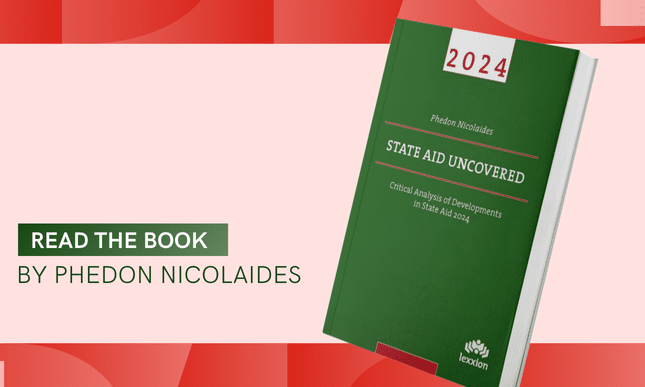
In Lexxions Blog „State Aid Uncovered” veröffentlicht Prof. Phedon Nicolaides wöchentlich kritische Analysen zu den neuesten Urteilen und Entscheidungen zu staatlichen Beihilfen. Jeder Beitrag stellt die wichtigsten Punkte eines Gerichtsurteils oder einer EU-Kommissionsentscheidung vor, ordnet sie in den Kontext ähnlicher Rechtsprechung oder Praxis ein, bewertet die zugrundeliegende Argumentation und zeigt etwaige Ungereimtheiten oder Widersprüche auf.

In loser Folge werden auf diesem Blog auch Gastbeiträge von anderen Experten für staatliche Beihilfen veröffentlicht, welche die Inhalte der Blogbeiträge ergänzen.

Jetzt abonnieren!

Professor at Maastricht University; Professor at University of Nicosia, and Academic Director at Lexxion Training

A New Temporary State aid Framework to Fight the Effects of the Corona Virus

Member States will be allowed to provide grants, guarantees and loans to companies to alleviate the effects of the corona virus. Introduction At the end of 2009, the European Commission adopted a Temporary Framework of State aid rules to enable Member States to support companies that were harmed by the outbreak of the financial crisis in 2008. Now, the corona […]

Has an Economic Myth Become a Legal Fact? The Case of Turnover Taxes

Progressive turnover taxes are not contrary to the freedom of establishment or the right of equal treatment. Introduction Recent cases involving “turnover” taxes have sparked a debate in the literature and on the conference circuit not only because they raise novel issues but also because of their implications for other taxes which are being mooted by European governments. As Advocate-General […]

Financial Transactions between the State and Banks with No State aid

Capital injections, state guarantees and loans granted to banks can be free of State aid if they are priced at market rates which reflect the risk borne by the state. Introduction If banks can obtain capital, loans and guarantees from the state at market rates why don’t they go directly to the market? No one has yet given a satisfactory […]

Public Funding of Infrastructure without State Aid

The existence of State aid must be checked at the level of both the direct and indirect beneficiaries who are the owners and users of infrastructure, respectively. If payments to private land owners are to be free of State aid, they must be calculated on the basis of an objective formula that takes into account the size and value of […]

Environmental Remediation and State Liability

Liability assumed by the state for the actions of an undertaking constitutes a selective advantage that may result in potential transfer of state resources in the future. Introduction On 16 January 2020 the General Court delivered its judgment in case T‑257/18, Iberpotash v European Commission.[1] Iberpotash, a Spanish company, appealed against Commission decision 2018/118. Iberpotash owns and operates potash mines […]

From Waste to Energy

State aid to incentivise the use of waste to produce energy must be individually notified. Introduction Waste management is an increasingly important aspect of policies aiming to prevent environmental degradation and slow down climate change. As the market for recycling expands and waste management becomes more profitable, there is also a higher risk of harm to competition by State aid. […]

An Important (and so far, Unique) Project of Common European Interest

State aid for important R&D projects of common European interest can cover different costs than the RDI Framework and at different rates of intensity. Introduction Several Member States have demanded a more active industrial policy to counteract perceived unfair foreign competition. The Commission’s response has partly been that current rules do allow cross-border cooperation for the development of innovative products. […]

How to Compensate for the Extra Cost of Public Service Obligations: Step-by-Step Guidance on a Complex Calculation

The “net avoided cost methodology” takes into account only incremental costs. Introduction The two most difficult issues in the design of State aid measures to support services of general economic interest [SGEI] are the proper definition of the public service obligation [PSO] and the identification of the “counterfactual” on the basis of which the public service compensation [PSC] is calculated. […]

State Aid Rules in the UK after Brexit: Alignment or Divergence?

The current rules will apply at least until 31 December 2020. Introduction On Saturday, 1 February 2020, the United Kingdom will no longer be a Member of the European Union. Will it then have to abide by EU State aid rules? According to the Agreement on the Withdrawal of the UK from the EU, the whole of the UK will […]

Public Subsidies to Households Can Be State aid

Support for individual borrowers can be indirect State aid to banks.   Introduction The fact that a public measure has social objectives and aims to help poor households or disadvantaged persons instead of undertakings does not necessarily remove it from the reach of State aid rules. During the past decade, in response to the economic crisis, a number of Member […]

I) Unlimited State Guarantees II) Effect on Trade

A competitor who wants to challenge a Commission decision authorising State aid without a formal investigation must, first, show that it is seriously harmed by the aid. Introduction This week’s article reviews two judgments: one on unlimited state guarantees granted by France [case T-135/17, Scor v European Commission][1] and another on aid that was found not to affect trade between Member […]

Not Every Compensation Is a Compensation in the Meaning of Altmark

Regulation and licensing do not constitute obligations for the provision of an SGEI. Compensation for changes in public policy is not compensation that complies with the Altmark conditions. Introduction The calculation of the compensation for the net extra costs of public service obligations [PSO] is a difficult task. On 15 May 2019, in case C-706/17, Achema et al v Lithuania […]

What Happens when Internal Market Rules and State Aid Rules Clash?

A tax refund may not be granted, if it constitutes non-notified State aid.   Introduction   It is a well-established principle that restrictions on internal market rights or freedoms may not be attached to a State aid measure. Indeed, current State aid rules [e.g. GBER, guidelines] explicitly exclude from their scope any aid measure which is inseparably linked to a […]

There Is No Threshold below which Economic Activities Can Be Considered to be Non-economic

Non-economic activities have to be accounted separately from economic activities. The exercise of public tasks assigned by the state cannot protect an undertaking from State aid rules. State aid distorts competition even when it aims to remedy distortions. Introduction Ports, like other transport infrastructures, may operate under public obligations some of which may be of economic and some of non-economic […]

Competitors’ Rights

A competitor must show that it is substantially affected by State aid approved by the Commission in order to challenge the Commission’s decision. Merely being affected by the aid is not enough. To show that aid has a substantial impact, it is first necessary to define the relevant market. This is different from the “distortion of competition” in the meaning […]

Land Development: The Case of Jaguar Land Rover Slovakia

Public funding of infrastructure which is not constructed for the specific needs of a company is not State aid.   Introduction An article carried by the Financial Times on 1 May 2019 revealed that Jaguar Land Rover [JLR] decided to make again the iconic Land Rover Defender. The production of this legendary off-roader ended about 10 years ago because it […]

The Commission Must Explain its Decision

A Commission decision that affects the legal position of an undertaking is actionable before EU courts. The opening of the formal investigation procedure must lead the Member State concerned to suspend the aid measure and may result in a recovery ruling by a national court. The Commission must be consistent in its reasoning. If it cannot use certain information at […]

State Control: The Case of EEG 2012

There is crucial difference between control by the state over resources and attribution to the state of the aid granting decision.   Introduction According to the latest edition of the State aid Scoreboard, in 2017 Member States granted a total of EUR 105 billion of State aid to manufacturing and services. Of that amount, 58% or EUR 61 billion supported […]

Spanish Football Clubs Score against the Commission: a) Linked Advantages and Disadvantages Must be Assessed Together b) In Determining the Existence of an Advantage, the Commission Must Explain both what it Takes into Account and what it Ignores

State measures which are linked and produce both positive and negative effects, must be considered together to determine whether they confer a net advantage to undertakings. Counter-guarantees must be taken into account to determine the existence of advantage even if they are provisional.   Introduction Member States have in a number of cases tried to defend tax reductions or tax […]

The Boundary between State and Private Resources

Discretion in the form of intervention can remove it from the control of the state.   Introduction Suppose a thug puts a gun to your head and demands your wallet. Because you have sentimental photos in your wallet, you offer instead the keys to your car. You would rather lose the car than the wallet. Can the thug claim in […]

Sie möchten einen Beitrag einreichen oder zur Weiterentwicklung des Blogs State Aid Uncovered beitragen? Weitere Details finden Sie auf der englischsprachigen Seite.

Gastbeitrag einreichen

Abonnieren Sie unseren Newsletter für aktuelle Informationen zu Entwicklungen, Konferenzen, Seminaren und Veröffentlichungen in Ihrem Interessenbereich.

Newsletter: Jetzt abonnieren