


Europäisches Beihilfenrecht Blog

State Aid Uncovered Blog

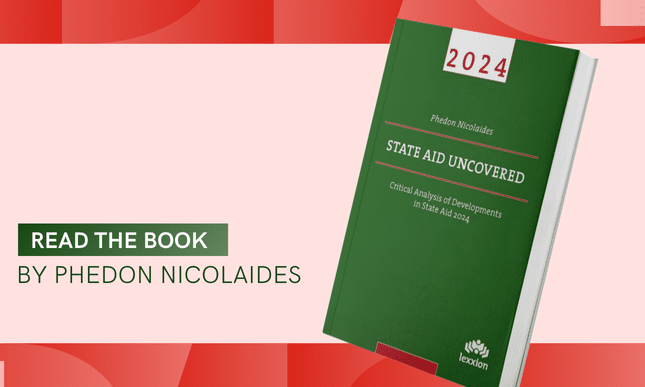
In Lexxions Blog „State Aid Uncovered” veröffentlicht Prof. Phedon Nicolaides wöchentlich kritische Analysen zu den neuesten Urteilen und Entscheidungen zu staatlichen Beihilfen. Jeder Beitrag stellt die wichtigsten Punkte eines Gerichtsurteils oder einer EU-Kommissionsentscheidung vor, ordnet sie in den Kontext ähnlicher Rechtsprechung oder Praxis ein, bewertet die zugrundeliegende Argumentation und zeigt etwaige Ungereimtheiten oder Widersprüche auf.

In loser Folge werden auf diesem Blog auch Gastbeiträge von anderen Experten für staatliche Beihilfen veröffentlicht, welche die Inhalte der Blogbeiträge ergänzen.

Jetzt abonnieren!

Professor at Maastricht University; Professor at University of Nicosia, and Academic Director at Lexxion Training

How to Make Good the Damage Caused by a Natural Disaster

Compensation for costs incurred as a result of a natural disaster is State aid. The compensation must be for damage directly caused by the natural disaster. Introduction State aid to make good the damage caused by an “exceptional occurrence” such as the corona virus covid-19 is compatible with the internal market. The legal basis for exemption is Article 107(2)(b). Of […]

Join our live webinar with Phedon Nicolaides on ‚COVID-19 and State Aid Law‘ on 2 April

Due to global developments and responding to various requests, Lexxion has created a live webinar to keep you updated on the latest news regarding the corona virus and State aid law. You can join from wherever you are and receive high-quality content at your (home) office.   In response to the Covid-19 pandemic, EU Member States are urgently rolling out […]

A New Temporary State aid Framework to Fight the Effects of the Corona Virus

Member States will be allowed to provide grants, guarantees and loans to companies to alleviate the effects of the corona virus. Introduction At the end of 2009, the European Commission adopted a Temporary Framework of State aid rules to enable Member States to support companies that were harmed by the outbreak of the financial crisis in 2008. Now, the corona […]

Has an Economic Myth Become a Legal Fact? The Case of Turnover Taxes

Progressive turnover taxes are not contrary to the freedom of establishment or the right of equal treatment. Introduction Recent cases involving “turnover” taxes have sparked a debate in the literature and on the conference circuit not only because they raise novel issues but also because of their implications for other taxes which are being mooted by European governments. As Advocate-General […]

Financial Transactions between the State and Banks with No State aid

Capital injections, state guarantees and loans granted to banks can be free of State aid if they are priced at market rates which reflect the risk borne by the state. Introduction If banks can obtain capital, loans and guarantees from the state at market rates why don’t they go directly to the market? No one has yet given a satisfactory […]

Public Funding of Infrastructure without State Aid

The existence of State aid must be checked at the level of both the direct and indirect beneficiaries who are the owners and users of infrastructure, respectively. If payments to private land owners are to be free of State aid, they must be calculated on the basis of an objective formula that takes into account the size and value of […]

Environmental Remediation and State Liability

Liability assumed by the state for the actions of an undertaking constitutes a selective advantage that may result in potential transfer of state resources in the future. Introduction On 16 January 2020 the General Court delivered its judgment in case T‑257/18, Iberpotash v European Commission.[1] Iberpotash, a Spanish company, appealed against Commission decision 2018/118. Iberpotash owns and operates potash mines […]

From Waste to Energy

State aid to incentivise the use of waste to produce energy must be individually notified. Introduction Waste management is an increasingly important aspect of policies aiming to prevent environmental degradation and slow down climate change. As the market for recycling expands and waste management becomes more profitable, there is also a higher risk of harm to competition by State aid. […]

An Important (and so far, Unique) Project of Common European Interest

State aid for important R&D projects of common European interest can cover different costs than the RDI Framework and at different rates of intensity. Introduction Several Member States have demanded a more active industrial policy to counteract perceived unfair foreign competition. The Commission’s response has partly been that current rules do allow cross-border cooperation for the development of innovative products. […]

How to Compensate for the Extra Cost of Public Service Obligations: Step-by-Step Guidance on a Complex Calculation

The “net avoided cost methodology” takes into account only incremental costs. Introduction The two most difficult issues in the design of State aid measures to support services of general economic interest [SGEI] are the proper definition of the public service obligation [PSO] and the identification of the “counterfactual” on the basis of which the public service compensation [PSC] is calculated. […]

Services of General Economic Interest: Proper Definition and Avoidance of Overcompensation

Member States need to demonstrate that public service obligations imposed on undertakings are necessary and proportional to the need for public service. A change in the funding of public services does not constitute new aid if it does not alter its objectives, the beneficiaries or the amount of aid by more than 20%.   Introduction It is a well-established principle […]

The Private Investor Principle in Air Transport – Part II

Public funds managed by private airport operators can be classified as state resources. Prices charged by airport operators can be used as a benchmark for market prices only if their activities and size are comparable and their costs are not subsidised by State aid. Before a private investor enters into any commercial arrangement, it takes into account all relevant information, […]

The Private Investor Principle in Air Transport – Part I

Public funds managed by private airport operators can be classified as state resources. Prices charged by airport operators can be used as a benchmark for market prices only if their activities and size are comparable and their costs are not subsidised by State aid. Before a private investor enters into any commercial arrangement, it takes into account all relevant information, […]

Justification of a Tax Exemption

Prevention of excessive taxation may justify tax exemption. Prevention of abuse may justify limits to the tax exemption.   Introduction   A tax exemption may not constitute state aid if it is justified by reasons which are linked to the nature or general scheme of the tax system. This is what the Court of Justice said on 19 December 2018, […]

Infrastructure Projects, State Guarantees and Distortion of Competition

State guarantees must be limited in duration and amount and the conditions for their mobilization must be defined in advance. Public funding to an operator in a closed sector does not affect trade and, therefore, does not constitute State aid.   Introduction Large infrastructure projects are complex, encounter many unforeseen problems and often fall behind schedule for years. Consider, for […]

The Date and Scope of Public Service Compensation

Aid is deemed to be granted on the date the beneficiary undertaking acquires the legal right to it, regardless of whether it is actually paid on that date. It is not enough for a public authority to define the service that it wants an operator to provide and the price that it should charge. It must also define where and […]

The Challenge of Identifying the Reference Tax System: The Spanish Goodwill Case, Again

To determine whether an aid measure is selective, the treatment of the beneficiaries has to be compared to those undertakings which are in a comparable position.   Introduction   On 15 November 2018, the General Court ruled in case T-239/11, Sigma Alimentos Exterior v European Commission.1 Sigma Alimentos Exterior (SAE), a Spanish company, appealed against Commission decision 2011/282 which found that […]

The Recovery of Incompatible Aid Cannot be Absolutely Impossible Unless it is first Attempted

Introduction In its ruling of 6 November 2018 in cases C‑622/16 P to C‑624/16 P, Scuola Elementare Maria Montessori v European Commission, the Court of Justice made it harder for Member States to escape from their recovery obligations.[1] Montessori appealed against the judgment of the General Court in case T‑220/13, Scuola Elementare Maria Montessori v European Commission. That judgment was reviewed here on […]

Legal Standing of Investors in Failed Banks

Investors that lodge claims before national courts for damages from resolution of banks have legal standing to request annulment of Commission decisions authorising State aid to those banks. Introduction It is now ten years since the start of the financial crisis. In these ten years, the Commission has adopted about 500 decisions dealing with State aid to banks and other […]

State Aid Provisions in the Draft Agreement on the Withdrawal of the UK from the EU

The agreement on the withdrawal of the UK from the EU requires compliance with EU State aid rules.   Introduction   On 14 November 2018, EU and UK negotiators finalised the text of the Agreement on the withdrawal of the UK from the EU.[1] The Agreement has to be ratified by the UK and the other 27 Member States. Given immediate […]

Sie möchten einen Beitrag einreichen oder zur Weiterentwicklung des Blogs State Aid Uncovered beitragen? Weitere Details finden Sie auf der englischsprachigen Seite.

Gastbeitrag einreichen

Abonnieren Sie unseren Newsletter für aktuelle Informationen zu Entwicklungen, Konferenzen, Seminaren und Veröffentlichungen in Ihrem Interessenbereich.

Newsletter: Jetzt abonnieren