


Europäisches Beihilfenrecht Blog

State Aid Uncovered Blog

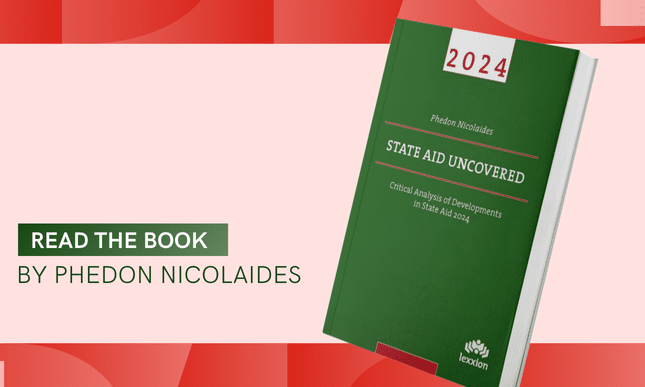
In Lexxions Blog „State Aid Uncovered” veröffentlicht Prof. Phedon Nicolaides wöchentlich kritische Analysen zu den neuesten Urteilen und Entscheidungen zu staatlichen Beihilfen. Jeder Beitrag stellt die wichtigsten Punkte eines Gerichtsurteils oder einer EU-Kommissionsentscheidung vor, ordnet sie in den Kontext ähnlicher Rechtsprechung oder Praxis ein, bewertet die zugrundeliegende Argumentation und zeigt etwaige Ungereimtheiten oder Widersprüche auf.

In loser Folge werden auf diesem Blog auch Gastbeiträge von anderen Experten für staatliche Beihilfen veröffentlicht, welche die Inhalte der Blogbeiträge ergänzen.

Jetzt abonnieren!

Professor at Maastricht University; Professor at University of Nicosia, and Academic Director at Lexxion Training

Compatible State Aid May Have Negative Effects on some Market Operators

The existence of market failure is not necessary for aid to be declared compatible under Article 107(3). Market failure does not mean that the market is completely unable to supply a good or service. State aid aiming to remedy market failure may be compatible with the internal market even if it has a negative impact on some market operators.   […]

New Video: Which types of State aid are compatible with the internal market?

What is State aid? Why do I need to be concerned about State aid? These and many more basic questions will be answered in our videos on YouTube. Make sure to visit us!   Last week Phedon Nicolaides gave examples of „good aid“. Today he explains which types of State aid are compatible with the internal market, such as environmental aid, regional development […]

State Aid to Electricity Intensive Users

The risk of relocation outside the EU is not accepted as a justification for the granting of State aid.   Introduction The European Commission has had to assess many measures of State aid to producers of electricity from renewable energy sources [RES producers or “green” electricity producers] and to intensive users of electricity [EIUs]. The former have benefitted from investment […]

New Video: When Is State Aid Allowed and What Is „Good Aid“?

What is State aid? Why do I need to be concerned about State aid? These and many more basic questions will be answered in our videos on YouTube. Make sure to visit us!   Last week Phedon Nicolaides gave „Practical Examples of State aid“, today he addresses the question „What type of aid is allowed?“. This aid is called „good aid“. […]

State Aid Modernisation: First Results

There has been an impressive increase in the use of the General Block Exemption Regulation. However, Member States still notify measures which are acknowledged by the Commission with “comfort letters”.   Introduction[1] In May 2012, the European Commission launched its State Aid Modernisation [SAM] initiative. After two years of consultations with the Member States, a set of new State aid […]

New Video: Practical Examples of State Aid

What is State aid? Why do I need to be concerned about State aid? These and many more basic questions will be answered in our videos on YouTube. Make sure to visit us!   After answering the question “Who can grant State aid?” last week, Phedon Nicolaides today gives you some practical examples of State aid such as subsidies by public authorities, […]

PART II: Combining Infrastructure Aid with SGEI Aid

After the spontaneous words on Brexit and State aid last week, I continue with the 2nd part of the post on infrastructure and SGEI today. A provider of services of general economic interest may receive both investment aid and compensation for the extra costs of public service obligations.   Part II: SGEI[1] Member States are free to determine the services […]

Court’s Diary – July 2016

Find below the court’s diary for all State aid cases this month. Would you like to write a comment on one of them? Please don’t hesitate and get in touch with us ([email protected]), we are happy to publish your comment on the blog.     Thursday 14/07/2016 Judgment in Case T-143/12 – Germany v Commission (General Court – Eigth Chamber) Tuesday 19/07/2016 […]

New Video: Who Can Grant State Aid?

What is State aid? Why do I need to be concerned about State aid? These and many more basic questions will be answered in our videos on YouTube. Make sure to visit us!   After answering the question “What is State aid?” in his last video, Phedon Nicolaides today speaks about “Who can grant State aid?”. Watch the video, comment and subscribe to […]

Brexit and State Aid: The Day After

The second part of the Lithuanian measure on the LNG terminal was scheduled to be published this week. In view of the referendum in favour of exit of the UK from the EU, the second part of the Lithuanian measure will be published next week. Instead, this week the focus is on the impact of Brexit on State aid. Introduction […]

How Injection of Public Capital Can Be Free of State Aid

Injection of public capital in an undertaking conforms with the market economy investor principle when: The public investment is equal and concomitant to private investment. The public investment has economic significance and is not followed by disengagement of private investors. The recipient undertaking is in a healthy financial position. The recipient undertaking compares favourably to its peers. The investment is […]

Restructuring Aid, Recovery of Aid and Procedural Rights

Restructuring aid can finance any part of a restructuring plan. Compensatory measures initiated before the granting of restructuring aid can be taken into account as long as they are linked to the restructuring itself. Member States have to comply with the conditions defined in Commission decisions. They cannot justify non-compliance on the grounds of domestic institutional difficulties. Regional authorities that […]

Public Service Obligations: A Few More Mistakes that Can Be Avoided

Even efficient companies will fail the 4th Altmark criterion if their costs are not proven to be comparable to those of a typical and well-equipped undertaking. Public funding of infrastructure is not State aid to users only if access is open to all. Public funding for training to raise social awareness is still State aid if it relieves companies of […]

A National Measure that Does Not Apply at Regional Level Is Not Necessarily Selective

Where there is a constitutional division of tax competences, different authorities may tax similar activities at different rates.   Introduction This article examines Commission decision SA.34469 on differential tax rates for online and land-based gambling in Spain.[1] In the Spanish political system, regions that have the status of Autonomous Communities have powers of taxation. The issue at hand was which authority […]

A Market Operator, unlike a Public Authority, Does not Have to Treat all Customers Equally

In managing infrastructure, a public authority acts as a private operator when it seeks a reasonable return on its investment and also takes into account the alternative of not operating the infrastructure. The manager of an infrastructural project may charge different fees to different users to optimise usage and increase revenue.   Introduction This article reviews Commission decision 2015/506 concerning […]

Do Free but Compulsory Tests Confer a Selective Advantage?

State aid rules apply to measures which are either harmonised at EU level or are left to the discretion of Member States. The protection of public health is no sufficient reason for removing a public measure from the scope of Article 107(1). The fact that undertakings are obliged by law to comply with certain tests does not justify the subsidisation […]

Land Development

The sale of land and buildings owned by a public authority conforms with the market economy operator principle when i) it is profitable, ii) there is no alternative transaction that is economically more attractive, and iii) the sale is as profitable as similar transactions concluded at the same time.   Introduction The article examines Commission decision 2015/507 concerning the sale […]

PART II: Green Electricity and Reduction of Energy Taxes for Energy-Intensive Users

Part II: Support of electricity production from renewable energy sources is normally compatible with the internal market. Reduction of taxes on electricity used by energy-intensive industries is allowed only for certain sectors exposed to international trade and only when they bear a certain cost. Taxes on imported electricity normally infringe free-trade and non-discrimination provisions, unless commensurate benefits are extended to […]

Green Electricity and Reduction of Energy Taxes for Energy-Intensive Users

Support of electricity production from renewable energy sources is normally compatible with the internal market. Reduction of taxes on electricity used by energy-intensive industries is allowed only for certain sectors exposed to international trade and only when they bear a certain cost. Taxes on imported electricity normally infringe free-trade and non-discrimination provisions, unless commensurate benefits are extended to imported electricity. […]

State Guarantees

The amount of State aid in a guarantee that makes possible the granting of a loan to a well-collateralised firm in difficulty is not the difference in premium but the difference in interest rates. Beneficiaries of guarantees not notified to the Commission do not have any remedy under EU law. Introduction   Last week’s article examined State aid in the […]

Sie möchten einen Beitrag einreichen oder zur Weiterentwicklung des Blogs State Aid Uncovered beitragen? Weitere Details finden Sie auf der englischsprachigen Seite.

Gastbeitrag einreichen

Abonnieren Sie unseren Newsletter für aktuelle Informationen zu Entwicklungen, Konferenzen, Seminaren und Veröffentlichungen in Ihrem Interessenbereich.

Newsletter: Jetzt abonnieren