

Europäisches Beihilfenrecht Blog

State Aid Uncovered Blog

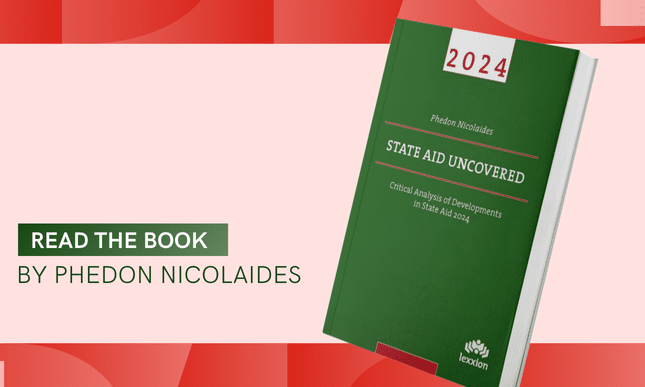
In Lexxions Blog „State Aid Uncovered” veröffentlicht Prof. Phedon Nicolaides wöchentlich kritische Analysen zu den neuesten Urteilen und Entscheidungen zu staatlichen Beihilfen. Jeder Beitrag stellt die wichtigsten Punkte eines Gerichtsurteils oder einer EU-Kommissionsentscheidung vor, ordnet sie in den Kontext ähnlicher Rechtsprechung oder Praxis ein, bewertet die zugrundeliegende Argumentation und zeigt etwaige Ungereimtheiten oder Widersprüche auf.

In loser Folge werden auf diesem Blog auch Gastbeiträge von anderen Experten für staatliche Beihilfen veröffentlicht, welche die Inhalte der Blogbeiträge ergänzen.

Jetzt abonnieren!

Professor at Maastricht University; Professor at University of Nicosia, and Academic Director at Lexxion Training

Land Development: The Case of Jaguar Land Rover Slovakia

Public funding of infrastructure which is not constructed for the specific needs of a company is not State aid.   Introduction An article carried by the Financial Times on 1 May 2019 revealed that Jaguar Land Rover [JLR] decided to make again the iconic Land Rover Defender. The production of this legendary off-roader ended about 10 years ago because it […]

The Commission Must Explain its Decision

A Commission decision that affects the legal position of an undertaking is actionable before EU courts. The opening of the formal investigation procedure must lead the Member State concerned to suspend the aid measure and may result in a recovery ruling by a national court. The Commission must be consistent in its reasoning. If it cannot use certain information at […]

State Control: The Case of EEG 2012

There is crucial difference between control by the state over resources and attribution to the state of the aid granting decision.   Introduction According to the latest edition of the State aid Scoreboard, in 2017 Member States granted a total of EUR 105 billion of State aid to manufacturing and services. Of that amount, 58% or EUR 61 billion supported […]

Spanish Football Clubs Score against the Commission: a) Linked Advantages and Disadvantages Must be Assessed Together b) In Determining the Existence of an Advantage, the Commission Must Explain both what it Takes into Account and what it Ignores

State measures which are linked and produce both positive and negative effects, must be considered together to determine whether they confer a net advantage to undertakings. Counter-guarantees must be taken into account to determine the existence of advantage even if they are provisional.   Introduction Member States have in a number of cases tried to defend tax reductions or tax […]

The Boundary between State and Private Resources

Discretion in the form of intervention can remove it from the control of the state.   Introduction Suppose a thug puts a gun to your head and demands your wallet. Because you have sentimental photos in your wallet, you offer instead the keys to your car. You would rather lose the car than the wallet. Can the thug claim in […]

The Incentive Effect of Public Funding of Infrastructure in Tranches

Public funding of functionally and commercially severable parts of an infrastructure project may have incentive effect even after construction is completed on some of the parts. A subsidy for the operation of a toll motorway may not constitute State aid.   Introduction State aid granted to a project that has already started lacks incentive effects and, therefore, cannot be found […]

National Authorities Must Recover Aid they Grant Mistakenly

Assurances from granting authorities cannot guarantee the legality of State aid. Aid recipients must verify that the aid is granted correctly.   Introduction The Commission must stop its misguided policy of not making public the answers it provides to Member States on questions of interpretation of the General Block Exemption Regulation [GBER]. This is one of the consequences of a […]

Many Tax Rulings Do Not Make a Single Aid Scheme

The autonomy that Member States enjoy in the field of direct taxation must be exercised in compliance with EU State aid law. A State aid measure is considered to be a “scheme” when (a) no further implementing acts are necessary, (b) the granting authority has no discretion in how the measure is applied and (c) the measure defines the eligible […]

How Can Incompatible State Aid Be Passed-on from one Company to another to Avoid Recovery?

Introduction State aid that is incompatible with the internal market has to be paid back, unless the repayment would be contrary to a general principle of EU law. Last November the Court of Justice ruled in case C‑622/16 P, Scuola Elementare Maria Montessori v European Commission that “(79) the principle that ‘no one is obliged to do the impossible’ is among the […]

How Much May a Non-Economic Entity Charge without Becoming an Undertaking?

The price should not cover more than 50% of the costs. Introduction An entity that does not make profit can still be an undertaking. However, an entity that charges a fee for its services is not necessarily an undertaking. The EU Court of Justice has never defined how low such a fee must be in order for that entity to […]

Public Procurement and State Aid

State aid does not have to be awarded on the basis of a competitive procedure, unless the relevant rules require it. Secondary legislation may allow Member States to make direct awards without a prior competitive procedure. Public procurement rules do not apply to awards between contracting authorities.   Introduction   Public procurement and State aid rules have the same basic […]

Public Service Compensation

Compensation for the provision of public services may not exceed the avoidable cost minus any forgone revenue from not having to provide those services. The VAT exemption for postal services is not State aid because it is laid down in the EU VAT directive and therefore cannot be attributed to Member States.   Introduction This article reviews Commission decision on […]

The European Commission’s Code of Best Practices on State Aid Procedures

Closer cooperation between Commission services and Member States.   Introduction   The European Commission, DG Competition, published on 16 July 2018 on its website and then on 19 July 2018 in the Official Journal of the EU a Code of Best Practices for the Conduct of State Aid Control Procedures.[1]The purpose of the Code is to provide guidance to Member […]

State Aid Control in the UK after its Exit from the European Union

After its withdrawal from the EU, the UK is likely to maintain a State aid regime that is similar to that of the EU.   Introduction   In seven months’ time, on 29 March 2019, the UK will leave the EU. But its withdrawal from the EU will not bring to an end compliance with EU rules. The UK is […]

The Compatibility of State Aid Depends on the Rules which are Applicable at the Time the Aid is Granted

Failure to comply with just a single provision of an exemption regulation results in the non-applicability of the whole regulation and makes any implemented aid measure automatically illegal. The compatibility of aid measures adopted in the past but continuing having effects are assessed not on the basis of old rules but on the basis of the rules which are applicable […]

The Definition of the Reference Tax System is still a Puzzle

A selective measure should be determined on the basis of its effects, not on the basis of the legally defined regulatory techniques.   Introduction A tax measure is selective in the meaning of Article 107(1) TFEU when it basically deviates from the normal tax system. In the case of a tax reduction or a tax exemption the normal system is […]

Danish Water Tax Exemption

A selective tax reduction does not constitute State aid if it does not confer an advantage that is proportionately larger than the magnitude of the tax reduction. A complete exemption of insignificant amounts of the taxable volume can be justified on the grounds of reducing administrative burden.     Introduction   Member States enjoy wide discretion to levy taxes on […]

The 2017 Annual Competition Report

Introduction   On 18 June 2018, the European Commission published its Annual Report on Competition Policy for 2017.[1] As usually, the Annual Report is accompanied by a Staff Working Paper that has almost four times as many pages as the Annual Report and provides more details on developments in all areas of competition policy, including State aid.The pre-eminent role of the […]

Revision of the GBER

Block exemption of new financial instruments.   Introduction   The Commission has recently published a proposal for amendment of Council Regulation 2015/1588[1] which authorises the Commission to adopt block exemption regulations. The purpose of the Commission’s proposal is to expand Article 1 of Regulation 2015/1588. This Article lists the categories of aid that may be declared compatible with the internal market.The […]

Remedying the Damage of a Natural Disaster through Incentives for New Investments

Damage from natural disasters can be remedied in the short-term through direct compensation or in the longer-term through investment subsidies to support new productive capacity.   Introduction   This article reviews a rather straightforward case which, however, is also quite unusual. It concerns a measure to remedy the effect of recent earthquakes in Italy. What makes it unusual is that […]

Sie möchten einen Beitrag einreichen oder zur Weiterentwicklung des Blogs State Aid Uncovered beitragen? Weitere Details finden Sie auf der englischsprachigen Seite.

Gastbeitrag einreichen

Abonnieren Sie unseren Newsletter für aktuelle Informationen zu Entwicklungen, Konferenzen, Seminaren und Veröffentlichungen in Ihrem Interessenbereich.

Newsletter: Jetzt abonnieren