


Europäisches Beihilfenrecht Blog

State Aid Uncovered Blog

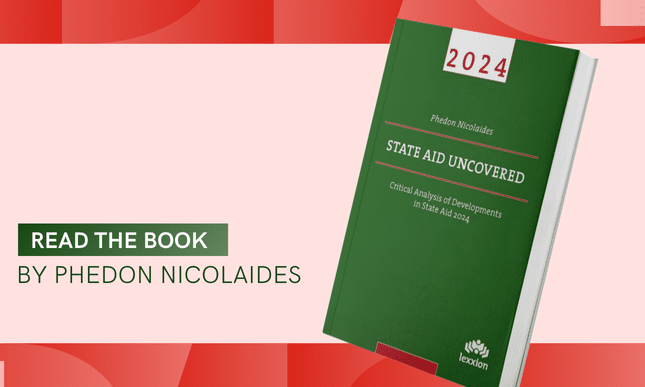
In Lexxions Blog „State Aid Uncovered” veröffentlicht Prof. Phedon Nicolaides wöchentlich kritische Analysen zu den neuesten Urteilen und Entscheidungen zu staatlichen Beihilfen. Jeder Beitrag stellt die wichtigsten Punkte eines Gerichtsurteils oder einer EU-Kommissionsentscheidung vor, ordnet sie in den Kontext ähnlicher Rechtsprechung oder Praxis ein, bewertet die zugrundeliegende Argumentation und zeigt etwaige Ungereimtheiten oder Widersprüche auf.

In loser Folge werden auf diesem Blog auch Gastbeiträge von anderen Experten für staatliche Beihilfen veröffentlicht, welche die Inhalte der Blogbeiträge ergänzen.

Jetzt abonnieren!

Professor at Maastricht University; Professor at University of Nicosia, and Academic Director at Lexxion Training

EU Rules do not Impose a Time Limit on the Power of National Courts to Deal with Non-notified Aid

State aid may affect trade even when the market concerned is not liberalised. This can happen when the aid recipient also has operations outside that market, which it can cross-subsidise. Claims for damages caused by illegal aid must be accorded the same treatment under national law as any other claim resulting from faulty decisions of the state.   Introduction A […]

Support for Non-Performing Loans in Cyprus

Public assistance to households to pay for their mortgages is not State aid. Public assistance to enterprises to pay for their loans may be qualified as de minimis aid. Public assistance to households and de minimis aid to enterprises to pay for their loans are indirect aid to banks, which, however, falls outside the directive on bank recovery and resolution […]

What Does a Private Investor Take into Account before Investing?

A private investor may invest in a troubled company that is restructuring is order to increase its future profitability.   Introduction   The answer to the question posed above is short and simple: everything relevant. A private investor does not ignore anything that can affect the profitability of the prospective investment.This implies that the other side of the coin is […]

Pari Passu Is not Static

When comparing the behaviour of public and private creditors, it is necessary to ensure that their situations and interests do not diverge over time.   Introduction   When an undertaking owes money to a public authority the latter must use all available legal means to recover the money, including the liquidation of the undertaking and the sale of its assets. […]

Services of General Economic Interest: Proper Definition and Avoidance of Overcompensation

Member States need to demonstrate that public service obligations imposed on undertakings are necessary and proportional to the need for public service. A change in the funding of public services does not constitute new aid if it does not alter its objectives, the beneficiaries or the amount of aid by more than 20%.   Introduction It is a well-established principle […]

The Private Investor Principle in Air Transport – Part II

Public funds managed by private airport operators can be classified as state resources. Prices charged by airport operators can be used as a benchmark for market prices only if their activities and size are comparable and their costs are not subsidised by State aid. Before a private investor enters into any commercial arrangement, it takes into account all relevant information, […]

The Private Investor Principle in Air Transport – Part I

Public funds managed by private airport operators can be classified as state resources. Prices charged by airport operators can be used as a benchmark for market prices only if their activities and size are comparable and their costs are not subsidised by State aid. Before a private investor enters into any commercial arrangement, it takes into account all relevant information, […]

Justification of a Tax Exemption

Prevention of excessive taxation may justify tax exemption. Prevention of abuse may justify limits to the tax exemption.   Introduction   A tax exemption may not constitute state aid if it is justified by reasons which are linked to the nature or general scheme of the tax system. This is what the Court of Justice said on 19 December 2018, […]

Infrastructure Projects, State Guarantees and Distortion of Competition

State guarantees must be limited in duration and amount and the conditions for their mobilization must be defined in advance. Public funding to an operator in a closed sector does not affect trade and, therefore, does not constitute State aid.   Introduction Large infrastructure projects are complex, encounter many unforeseen problems and often fall behind schedule for years. Consider, for […]

The Date and Scope of Public Service Compensation

Aid is deemed to be granted on the date the beneficiary undertaking acquires the legal right to it, regardless of whether it is actually paid on that date. It is not enough for a public authority to define the service that it wants an operator to provide and the price that it should charge. It must also define where and […]

Sector-Specific Tax Exemptions

A measure that covers a whole sector can be selective. Distortions caused by the policies of other Member States cannot justify the granting of State aid. The purpose of State aid is not to ensure equal conditions of competition across Member States.   Introduction On 31 May 2018, the General Court ruled in case T-160/16, Groningen Seaports v European Commission.[1] Groningen […]

State Aid for the Deployment of Broadband Networks

Most State aid for the development of broadband networks is approved by the Commission. But the aid must be limited only to areas where market-based investments are unlikely to be made without aid.   Introduction   This article reviews a recent Commission decision authorising State aid for broadband development in the Netherlands which is one of the most networked countries […]

The Extent of the Discretion of Member States to Define Services of General Economic Interest (SGEI)

A service is classified as an SGEI not only when it is important for citizens but also when the market does not adequately supply it and one or more undertakings are compelled to provide it to specified consumers, in specified areas and on specified terms.   Introduction   The Treaty on the Functioning of the EU and the case law […]

Exemptions from Product-Specific Taxes

Tax exemptions do not constitute State aid when they aim to induce change in the behaviour of consumers, when they distinguish between harmful products and non-harmful products and for reasons of administrative simplicity.   Introduction   In the past two weeks, an article was published in two parts criticising the judgments of the Court of Justice in three cases of […]

Exemption from Taxes that Protect the Environment May not be Selective – Part II

Member States have discretion to impose taxes that penalise environmentally harmful activities. Exemption of undertakings whose activities do not harm the environment does not constitute State aid whenever the exempted undertakings are not in a comparable situation.   Application of Article 107(1) to the Asturias tax   In this case, exempted establishments were those with sales area less than 4000m2 or […]

Exemption from Taxes that Protect the Environment May not be Selective – Part I

Member States have discretion to impose taxes that penalise environmentally harmful activities. Exemption of undertakings whose activities do not harm the environment does not constitute State aid whenever the exempted undertakings are not in a comparable situation.   Application of Article 107(1) to the Asturias tax   In this case, exempted establishments were those with sales area less than 4000m2 or […]

Dealing with Problematic Banks

The sale of a bank through a fair, open, competitive and transparent procedure that maximises the value of the assets and liabilities is free of State aid.   Introduction This week’s article returns to the theme of State aid to banks and examines a case of “precautionary” recapitalisation and a case of sale of a bank, that was linked to […]

Compensation for Public Service Obligations

Compensation for public service obligations may be fixed at less than the net extra costs of the provider of the public service to induce it to become more efficient.   Introduction   Every three years the UK determines the compensation it provides to the Post Office Limited (POL) for the extra costs of the public services it provides. Commission decision […]

Liquidity Support to Banks

Banks that receive State aid are considered to be failing banks, except when the aid is granted to solvent banks for the purpose of precautionary recapitalisation or temporary liquidity.   Introduction   During the past decade, large amounts of public funds have been committed to shore up failing or illiquid banks. Under current banking rules, the mere fact that a […]

Complaints about Billboards and Welfare Services

A regulatory measure may affect competition but it does not constitute State aid. Administrative changes to existing aid measures do not result in new State aid.   Introduction This article reviews two Commission decisions: one concerning a Czech regulatory measure and another concerning existing aid to German social organisations. Both decisions dealt with complaints about alleged illegal State aid.   […]

Sie möchten einen Beitrag einreichen oder zur Weiterentwicklung des Blogs State Aid Uncovered beitragen? Weitere Details finden Sie auf der englischsprachigen Seite.

Gastbeitrag einreichen

Abonnieren Sie unseren Newsletter für aktuelle Informationen zu Entwicklungen, Konferenzen, Seminaren und Veröffentlichungen in Ihrem Interessenbereich.

Newsletter: Jetzt abonnieren