

Europäisches Beihilfenrecht Blog

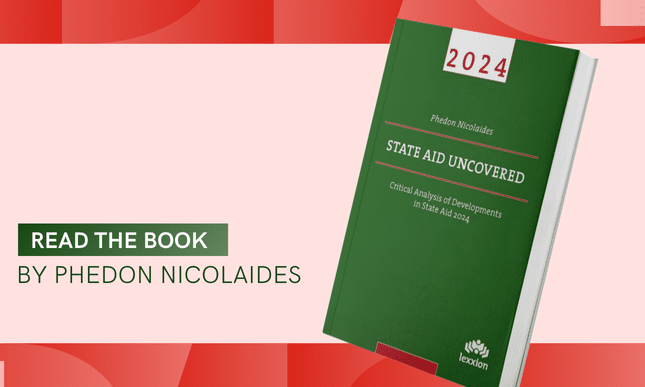
State Aid Uncovered Blog

In Lexxions Blog „State Aid Uncovered” veröffentlicht Prof. Phedon Nicolaides wöchentlich kritische Analysen zu den neuesten Urteilen und Entscheidungen zu staatlichen Beihilfen. Jeder Beitrag stellt die wichtigsten Punkte eines Gerichtsurteils oder einer EU-Kommissionsentscheidung vor, ordnet sie in den Kontext ähnlicher Rechtsprechung oder Praxis ein, bewertet die zugrundeliegende Argumentation und zeigt etwaige Ungereimtheiten oder Widersprüche auf.

In loser Folge werden auf diesem Blog auch Gastbeiträge von anderen Experten für staatliche Beihilfen veröffentlicht, welche die Inhalte der Blogbeiträge ergänzen.

Jetzt abonnieren!

Professor at Maastricht University; Professor at University of Nicosia, and Academic Director at Lexxion Training

Summary of Lexxion Seminar: State aid for Tax Measures on 26-27 October 2015, Brussels

The following is a summary of the main points that were presented and the issues that were discussed in the seminar on State aid in Tax Measures that was held in Brussels on 26-27 October 2015. The summary has been prepared for information purposes only and it is not meant to be a precise record of the proceedings of the […]

Sale of Public Land and Conditions for Credible Expert Valuation

The value of land corresponds to its market price that can be determined through open and unconditional bidding. If a price cannot be determined through bidding, then expert valuation is an alternative method for establishing the value of land. Expert valuation has to be carried out ex ante, by a recognised independent surveyor, on the basis of reasonable assumptions and […]

Court’s Diary – November 2015

Find below the court’s diary for all State aid cases. Would you like to write a comment on one of them? Please don’t hesitate and get in touch with us ([email protected]), we are happy to publish your comment on the blog.   Wednesday 11/11/2015 Judgment in Case C-505/14 – Klausner Holz Niedersachsen (Court of Justice – Second Chamber) Thursday 12/11/2015 Judgment in […]

Economic Continuity and Recovery of Incompatible State Aid

Incompatible State aid must be recovered from “successor” companies which acquire previously aided companies and enable the latter to continue their operations without any change.     Introduction In this article I review two decisions in which the Commission determined that incompatible aid had to be recovered from “successor” companies. Those were companies which had obtained the assets of the […]

The Perennial Altmark Questions

A SGEI provider does not have to be efficient by industry standards in order to receive compensation for its next extra costs. Although the conditions for compatibility of public service compensation under Article 106(2) TFEU appear to be similar to the Altmark criteria, they have very different objectives.   Introduction Even since the Altmark judgment of July 2003, public authorities […]

A new misnomer in State aid law: single economic unit with separate legal personality (C 357/14 P, Dunamenti Erőmű/Commission)

The following blog post is a contributory piece by Emanuela Matei, Associate Researcher at the Centre of European Legal Studies, Bucharest. Matei holds a Juris Master in European Business Law (Lund University, June 2012), a Magister legum (Lund University, June 2010) and a BSc in Economics & Business Administration (Lund University, June 2009). We are very glad to welcome her […]

Should State Aid that Is Passed on to Consumers Not be Recovered?

Should the amount of recoverable aid be similarly reduced by the amount that is allegedly passed on to consumers? I will argue the case against it.   Introduction On 5 February 2015, the General Court, in cases T-473/12, Aer Lingus v Commission[1] and T-500/12, Ryanair v Commission[2], annulled Article 4 of Commission Decision 2013/199. In that decision the Commission found that a […]

A Primer on Compensation for the Extra Costs of Public Service Obligations Taking into Account Efficiency Gains

When Member States impose PSOs they are never allowed to grant even a single euro in excess of the net extra costs of the PSO. That is prohibited for the simple reason that it results in over-compensation.     Introduction The Lexxion seminar on state aid for transport and transport infrastructure that took place in Brussels on 21-22 September (view […]

Courts’s Diary – October 2015

Any comments on #Stateaid? Get in touch: Stateaidhub[at]lexxion.eu   Thursday 01/10/2015 Judgment in Case C-357/14 P – Electrabel and Dunamenti Erőmű v Commission (Court of Justice – Third Chamber)   Tuesday 06/10/2015 Judgment in Case C-303/13 P – Andersen v Commission (Court of Justice – Grand Chamber)   Thursday 08/10/2015 Hearing in Joined Cases T-479/11 & T-157/12 – France v Commission, […]

The State Acting as a Private Creditor & State Aid Enforcement and Procedural Rights

In this article I review Commission decision SA.37100 on JSC Liepajas Metalurgs [LM], once Latvia’s largest steel company and major employer. The decision examines whether Latvia acted promptly to recover a debt owed to it by a company that faced financial difficulties. The question was whether Latvia acted as a private creditor when it allowed the debtor to continue operations. […]

A JESSICA-Funded Public-Private Partnership

Public funding of a public-private partnership for the construction and maintenance of public schools may still involve State Aid. State Aid may have an incentive effect even when it is granted to a project that has already started. The funding gap method can demonstrate the necessity and proportionality of State Aid. Introduction   This article reviews Commission Decision SA.37168 concerning the construction […]

Price Discounts and Compensation for Public Service Obligations: A Case of Questionable Need for Aid

SGEI can be defined and public service obligations can be imposed only when the market underprovides. The parameters of compensation must be determined in advance. Public service compensation may not exceed the next extra costs of the SGEI or PSO. Member States are free to devise their own method of compensation, but irrespective of the method used, compensation must comply with the basic […]

The Cost of not Recovering Incompatible Aid

The Commission is not obliged to quantify precisely the amount of aid that has to be recovered. The Member State that fails to recover incompatible aid or fails to recover all of it risks legal action against both before national and EU courts. The Commission may initiate infringement proceedings and request the Court of Justice to impose penalties against the failing Member […]

The Importance of Precise Definition of Public Service Obligations

The imposition of a public service obligation must be preceded by market analysis that shows that the market underprovides. For compensation of public service obligations to be compatible aid, it must satisfy the first three Altmark criteria. Surprisingly, the first three Altmark criteria must also be satisfied [in addition to the 4th criterion] for public service compensation in order not to constitute […]

Market Operator in Electricity Distribution: Long-term Purchasing Agreements Must Balance Risks and Rewards

A market operator accepts to be bound in long-term contracts, which entail more risk because market conditions may change, only when he gets compensated with more certainty that costs will remain stable. Contractual clauses which vary from standard commercial practice are suspect. A measure can be selective even when it uses objective criteria to define eligible beneficiaries. Trade can be affected and competition […]

The Perils of Ex Post Compensation of Public Services Obligations

Providers of SGEI must maintain separate accounts. Parameters of compensation must be determined in advance. Ex-post formulation is not in conformity with State aid rules. Ex-post calculation of compensation that covers all costs and eliminates commercial risk is not compatible with State aid rules. Introduction   The calculation of the compensation to be offered to providers of services of general economic interest […]

The New Guidelines on State Aid for Environmental Protection and Energy, 2014-2020

The new guidelines are wider in scope: They also cover energy infrastructure, energy capacity and reductions from electricity levies. The new guidelines have higher thresholds for individual notifications. They allow higher aid intensity when aid is granted through competitive bidding. They require more rigorous application of the principles of necessity and proportionality of aid. Introduction   In 2012, the latest year for which […]

A Textbook Case of False Arguments: T-150/12, Greece v Commission

Recipients of State aid obtain an advantage even if they do not succeed to improve their position on the market. Recipients of State aid obtain an advantage whenever their competitors in intra-EU trade do not receive the same aid from the same source. Even small amounts of aid can disturb intra-EU trade where there is strong cross-border competition. The European Commission is not […]

Two Judgments: a) Unlimited State Guarantees and b) The Discretion of the Commission in Restructuring Measures

Unlimited state guarantees are never compatible with the internal market. The existence of an unlimited guarantee and its benefits can be inferred from the relevant legal context in which the state assumes certain obligations towards creditors. The Commission may impose both structural and behavioural remedies on recipients of restructuring aid These remedies may cover sectors other than the main sector in which […]

The Importance of a Correct Framing of the Private Creditor and Private Investor Tests

A public authority acting as private creditor must exhaust all legally available means of recovering money owed to it. A private creditor may agree to an amicable arrangement – depending on the complexity and duration of legal proceedings, the value of the collateral it holds and the chances of long-term viability of the debtor – if it results in repayment of […]

Sie möchten einen Beitrag einreichen oder zur Weiterentwicklung des Blogs State Aid Uncovered beitragen? Weitere Details finden Sie auf der englischsprachigen Seite.

Gastbeitrag einreichen

Abonnieren Sie unseren Newsletter für aktuelle Informationen zu Entwicklungen, Konferenzen, Seminaren und Veröffentlichungen in Ihrem Interessenbereich.

Newsletter: Jetzt abonnieren