


Europäisches Beihilfenrecht Blog

State Aid Uncovered Blog

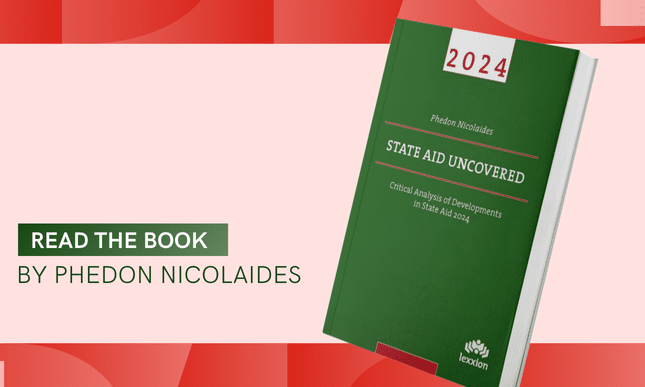
In Lexxions Blog „State Aid Uncovered” veröffentlicht Prof. Phedon Nicolaides wöchentlich kritische Analysen zu den neuesten Urteilen und Entscheidungen zu staatlichen Beihilfen. Jeder Beitrag stellt die wichtigsten Punkte eines Gerichtsurteils oder einer EU-Kommissionsentscheidung vor, ordnet sie in den Kontext ähnlicher Rechtsprechung oder Praxis ein, bewertet die zugrundeliegende Argumentation und zeigt etwaige Ungereimtheiten oder Widersprüche auf.

In loser Folge werden auf diesem Blog auch Gastbeiträge von anderen Experten für staatliche Beihilfen veröffentlicht, welche die Inhalte der Blogbeiträge ergänzen.

Jetzt abonnieren!

Professor at Maastricht University; Professor at University of Nicosia, and Academic Director at Lexxion Training

How to Determine the Selectivity of a Tax Measure

A tax exception is normally a selective measure. However, exceptions which are open to all undertakings are not selective, even if they deviate from the standard tax rate or base. Exceptions which are open only to a few undertakings escape from being classified as selective only when the beneficiary undertakings are in a different legal or factual situation than non-beneficiaries. […]

The Boundaries of Non-Economic Infrastructure and the Limits of the Funding Gap Method

Public funding of assets which are used exclusively by certain undertakings constitutes State aid. If the state chooses to fund certain assets or activities, then it must do so consistently in all regions and in relation to all affected undertakings.   Introduction A typical mission of the state is to provide public goods. Normally public funding of public goods is […]

Connecting Public and Private Infrastructure

Public funding of public infrastructure is not State aid. Public funding of connections between public and private infrastructure is not State aid as long as it is open to all users and no fee is charged.   Introduction Last week’s article examined the use of a port facility. This week the focus is on a related issue: investment in port […]

Possible Advantage from the Exclusive Use of Public-Funded Infrastructure

The exclusive use of a public asset or an asset funded by public money may confer an advantage in the meaning of Article 107(1) TFEU if several competitors express their interest to use the same asset.   Introduction As public authorities are becoming more aware that placing public assets at the disposal of undertakings can involve State aid, they increasingly […]

Court’s Diary – February 2016

Find below the court’s diary for all State aid cases. Would you like to write a comment on one of them? Please don’t hesitate and get in touch with us ([email protected]), we are happy to publish your comment on the blog   Thursday 04/02/2016 Judgment in Case T-287/11 – Heitkamp BauHolding v Commission (General Court – Ninth Chamber) Judgment in […]

Nature Conservation as a Service of General Economic Interest

Public funding of non-economic activities does not create State aid problems when any related economic activities are clearly separated. The 2012 SGEI package can apply retroactively.   Introduction Member States of the European Union are free to designate the services they consider to be in the general economic interest. However, the wide discretion they enjoy in this respect falls under […]

Is there an Advantage when the State Pays for Compulsory Milk Tests?

Undertakings obtain an advantage when the state pays for their normal costs. Normal costs are costs which are inherent in the operations of undertakings. The costs of meeting legal obligations are normal.   Introduction The case law on advantage in the meaning of Article 107(1) TFEU says that aid confers an advantage to undertakings when they obtain a benefit that […]

Valuation of Assets Disposed by the State

The value of an asset can be determined according to different methods. The main methods examine future income or comparable transactions or stock market valuation. Agreements between sellers and buyers that contain indemnification clauses or settle past claims do not reflect the true market value of the sold asset.   Introduction 9 December 2015, the General Court rendered its judgment […]

An Exception Is Not Necessarily Selective: The Case of the Spanish Tax Lease [1]

An exception from a tax system is not selective if it is a priori open to any tax payer. Checks by tax authorities to ensure that a measure is applied correctly do not constitute exercise of administrative discretion that may render a measure de facto selective. The impact of a measure on trade and competition cannot be merely presumed just […]

Court’s Diary – January 2016

Find below the court’s diary for all State aid cases. Would you like to write a comment on one of them? Please don’t hesitate and get in touch with us ([email protected]), we are happy to publish your comment on the blog.     Thursday 28/01/2016 Judgment in T-507/12 -Slovenia v Commission (General Court – Fifth Chamber) Do you know we also publish […]

Levying Taxes to Fund Public Broadcasters

Taxes may not be examined by the Commission in the context of Article 107 even if they finance State aid measures. By contrast, the Commission may examine a tax in the context of its assessment of the compatibility of aid with the internal market when the tax is inseparable from an aid measure. A tax is inseparable from an aid […]

A Textbook Case of i) How to Sell Public Assets without Passing on Incompatible State Aid to the Buyer, and ii) How to Work together with the Commission

An undertaking that has received incompatible State aid must pay it back or, if it cannot, it must be liquidated. Before a recipient of possibly incompatible State aid is liquidated, its assets can be sold off to the highest bidder. The buyer of previously subsidised assets does not benefit from State aid if i) it pays a market price and […]

Management of Port Infrastructure through a very long Concession Contract: Is the Funding Gap Method Meaningful?

Competitive selection of the operator of an infrastructural facility normally eliminates State aid. However, modifications to the contract after the operator is selected may confer an advantage that constitutes State aid. Public funding that is calculated on the basis of the “funding gap” method ensures that the aid is necessary and proportional. Introduction   Several recent articles in the blog […]

The Profitability of an Investment Must be Determined Ex Ante

Internal transfer of capital which is not used to fund new economic activities is not State aid. Injection of fresh capital to satisfy solvency and liquidity requirements still has to comply with State aid rules. A private investor always has the option of not injecting new capital and may opt instead to close down the business. A private investor always […]

Benchmarks of Profitability for Private Investors

A public authority that injects capital in an undertaking [or provides any other kind of finance] must ensure that the funding can achieve the rate of return that can, in principle, satisfy a private investor. The rate that can satisfy a private investor and ensure that the funding is free of State aid is the rate that covers the cost of […]

Sale of Public Assets, SGEI and Electricity Levies

Revenue from levies on electricity users is most likely to constitute State resources. Public service obligations can be transferred from one electricity-generating company to another. Compensation for public service obligations may distinguish between controllable and uncontrollable costs. Performance benchmarking can be used as a means for inducing efficiency. Electricity levies may not directly or indirectly discriminate against imported electricity. Introduction   This is a […]

Capital Injection that Turns out to be Incompatible State Aid

Public authorities and the entities they control need to ensure that injection of public money in an undertaking must satisfy the market economy investor principle, otherwise it will be considered to be State aid. Public funding of an undertaking in difficulty has to be preceded by an ex ante assessment that can show that either the recipient will be turned around […]

The New General Block Exemption Regulation: The Cornerstone of the State Aid Regime, 2014-2020

The new GBER at a glance Common Provisions: aid must be transparent, must have incentive effect, rules on cumulation, and aid measures and awards must be published. Specific Provisions: Thirteen categories and many types of aid. Exclusions: no export aid, no mandated use of domestic products, no aid to firms in difficulty, no provisions that violate EU law, and no aid to […]

Land Development without State Aid

Activities which are part of the performance of public duties are non-economic in nature [e.g. spatial development]. Public funding of these activities does not constitute State aid. The transfer of resources from one level of government to another is transfer between public authorities and does not constitute State aid. Competitive selected developers obtain no advantage. Purchasers of subsidised assets who pay market prices […]

Transparency Is also Needed at the European Commission Level

As more State aid measures in the future will be granted on the basis of the General Block Exemption Regulation, Member States will have to make the aid they grant more transparent. More transparency should prevent the granting of State aid that is incompatible with the internal market. However, Member States should also be assisted in identifying which public measures may contain […]

Sie möchten einen Beitrag einreichen oder zur Weiterentwicklung des Blogs State Aid Uncovered beitragen? Weitere Details finden Sie auf der englischsprachigen Seite.

Gastbeitrag einreichen

Abonnieren Sie unseren Newsletter für aktuelle Informationen zu Entwicklungen, Konferenzen, Seminaren und Veröffentlichungen in Ihrem Interessenbereich.

Newsletter: Jetzt abonnieren