


Europäisches Beihilfenrecht Blog

State Aid Uncovered Blog

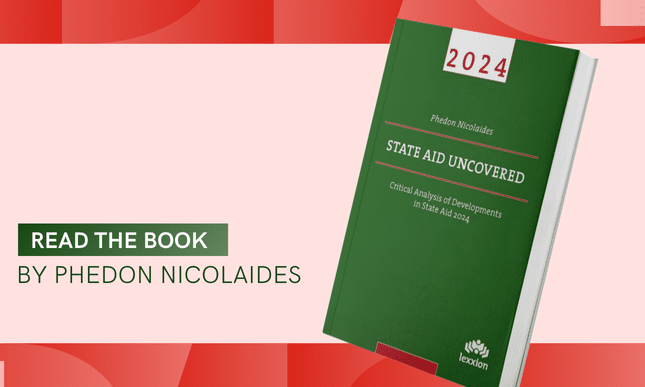
In Lexxions Blog „State Aid Uncovered” veröffentlicht Prof. Phedon Nicolaides wöchentlich kritische Analysen zu den neuesten Urteilen und Entscheidungen zu staatlichen Beihilfen. Jeder Beitrag stellt die wichtigsten Punkte eines Gerichtsurteils oder einer EU-Kommissionsentscheidung vor, ordnet sie in den Kontext ähnlicher Rechtsprechung oder Praxis ein, bewertet die zugrundeliegende Argumentation und zeigt etwaige Ungereimtheiten oder Widersprüche auf.

In loser Folge werden auf diesem Blog auch Gastbeiträge von anderen Experten für staatliche Beihilfen veröffentlicht, welche die Inhalte der Blogbeiträge ergänzen.

Jetzt abonnieren!

Professor at Maastricht University; Professor at University of Nicosia, and Academic Director at Lexxion Training

Legitimate Expectations and the “Right” to State Aid

Legitimate expectations can only be created by EU institutions giving unambiguous and unconditional assurances. No undertaking enjoys a right to State aid. Member States may reduce the amount of State aid they grant. Introduction As the process of transition to green economy accelerates, Member States have been reducing the subsidies they promised to grant to the early investors in the […]

Is Anyone who is Affected by State Aid an “Interested Party” that can Challenge a Commission Decision?

A non-competitor cannot normally claim to be “interested party”. The Commission does not have to prove to the normal legal standard the existence of state aid when it opens the formal investigation procedure. Introduction This week’s article reviews two recent judgments: one on the status of “interest party” and another on the obligations of the Commission when it opens the […]

Security of Supply May Justify a Deviation from Public Procurement Rules

Security of supply justifies a deviation from the normal procurement procedures as long as the same security cannot be achieved through a competitive selection of suppliers. Introduction Point 19 of the 2012 SGEI Framework requires that the assignment of a public mission to an undertaking must comply with the applicable public procurement rules. It does not impose an obligation for […]

What the Commission Must Find Out in the Preliminary Examination of State Aid: The Lessons from Tempus Energy on what is Sufficient Information

The Commission must open the formal investigation procedure when it has serious doubts based on the information available to it. Introduction Once I asked an administrator of an institute where I used to work why I was not informed about certain benefits that were available to staff. “Because you did not ask”, he answered. How could I ask about something […]

A Faulty Sale Procedure Can Lead to Presumption of State Aid and Annulment of a State Aid Decision

A sale of public assets cannot be presumed to be free of State aid when bidders are not treated equally. Introduction When the state sells a company it owns, there is a presumption that no State aid benefits either the buyer or the company that is sold if the sale is open transparent, non-discriminatory, unconditional and the chosen buyer is […]

Market Economy Operator Test: Timisoara Airport & Wizz Air

Public funding of activities that fall within the remit of the state does not constitute state aid. Although the presence of a credible ex ante business plan based on realistic assumptions is a strong indicator that the MEOT is satisfied, its absence does not necessarily prove that the MEOT is failed. Introduction Following a complaint by Carpatair, the European Commission […]

Pricing of Guarantees

A market guarantee premium must cover all costs assumed by the guarantor including the cost of possible default, cost of capital and the cost of administering the guarantee. Introduction Financial instruments are much in vogue. The Pan-European Guarantee Fund and to a smaller extent the Recovery and Resilience Fund are implemented through financial instruments that seek to leverage private participation. […]

Assignment of Public Service Obligations

The compensation for public service obligations may include reasonable profit and incentives for cost reduction. Introduction Member States have discretion to define services they consider to be in the general economic interest [SGEI]. However, they need to justify that definition. The Court of Justice has ruled on numerous occasions that an SGEI has “special characteristics” that set it apart from […]

Public Funding of an Undertaking in a Closed Sector

Public funding of undertaking in a closed sector [legal monopoly] does not distort competition and therefore does not constitute State aid. A legal monopoly has to conform with internal market rules. Introduction In July 2017, the Commission received a complaint by “C” [the complainant] alleging that Germany had granted State aid to two companies, RVV and Nordwasser, which supplied fresh […]

It is Difficult to Challenge a Commission Decision Opening the Formal Investigation Procedure

The assessment of the Commission in an “opening decision” is only provisional. The Commission is not required to prioritise its investigations or to extend them to anyone who may be in a similar situation. The right of non-discrimination is not violated when the Commission chooses to investigate some instead of all possible cases of State aid. An individual measure that […]

Compensation for Universal Service Provision

As long as the compensation does not exceed the net extra costs of the universal service activities, it may be used to offset other costs. Introduction The rules on State aid for services of general economic interest [SGEI] are very generous because they allow both investment and operating aid. Yet, it is not easy to comply with those rules because […]

State Aid and Essential National Interest

State aid that is necessary for protecting essential national interests can be compatible with the internal market. Introduction State aid should support outcomes that the market by itself cannot achieve. This implies that State aid that is restricted to only one or a few undertakings is unlikely to be capable of delivering the desired outcome. Yet, sometimes there may be […]

State Aid Measures May not be Funded through Discriminatory Taxes

A tax that is levied on both imported and domestic products but its revenue finances only domestic products infringes fundamental provisions of the EU Treaty. Introduction Member States finance the generation of electricity from renewable energy sources [RES] with revenue they raise through levies or charges on consumers of electricity. On 14 April 2021, the General Court in judgment in […]

Turnover Taxes Can Be Progressive without Being Selective

Progressive rates can be part of a reference tax system. The reference tax system is, in principle, made up of the tax base, the tax rates and the taxable events. Introduction Progressive turnover taxes were thought to be selective because they are levied on gross revenue before costs are deducted and larger volumes of revenue are taxed at higher rates. […]

Individual Aid Measures to Combat Covid-19

Aid to remedy a serious economic disturbance may be granted to a single company that is important for the national economy. EU law does not extend to competitors a right to the same aid. Introduction Between March 2020 and April 2021, the European Commission has authorised aid totalling more than EUR 2.5 trillion to remedy the serious economic disturbance caused […]

Draft New RDI Framework

The new RDI Framework provides continuity with clarity. On Monday, 19 April 2021, the European Commission published the new Regional Aid Guidelines for the period 2022-2027. They can be accessed at: https://ec.europa.eu/competition/state_aid/regional_aid/RAG_2021_adopted_communication.zip Introduction On 8 April 2021, the European Commission published the text of the draft new RDI Framework and launched public consultation.[1] The draft RDI Framework is accompanied by […]

State Guarantee to an Energy Project

A state guarantee can bridge the funding gap of an infrastructure project. Introduction State aid rules allow energy infrastructure projects to be supported by as much aid as is necessary to bridge their “funding gap”; i.e. the difference between the initial investment cost and the present value of their expected net operating revenue which is the future gross revenue minus […]

Lease Contracts and Competitive Selection

Vague award criteria can be discriminatory and harm the transparency of the selection procedure. Introduction After receiving a complaint, the Commission opened a formal investigation into alleged State aid granted by the Estonian Ministry of Rural Affairs to AS Tartu Agro, a private limited company, which produced milk, meat and cereals. According to the complaint, the Ministry had granted unlawful […]

“Global” Assessment of Tax Schemes

It is incumbent on the Commission to carry out a global assessment of tax schemes. But it must take into account only those provisions of schemes that apply ex ante and do not depend on the circumstances of individual tax payers. Only when aid has to be recovered must the provisions that apply to the specific circumstances of individual tax […]

Exclusive Rights and State Aid

Exclusive rights may constitute State aid if they mandate payments with resources over which the state can exercise control. Compensation for the cost of public service obligations may be granted only if the obligations are clear and define a service that is different from market services. Introduction Article 106(1) TFEU requires Member States not to distort competition when they grant […]

Sie möchten einen Beitrag einreichen oder zur Weiterentwicklung des Blogs State Aid Uncovered beitragen? Weitere Details finden Sie auf der englischsprachigen Seite.

Gastbeitrag einreichen

Abonnieren Sie unseren Newsletter für aktuelle Informationen zu Entwicklungen, Konferenzen, Seminaren und Veröffentlichungen in Ihrem Interessenbereich.

Newsletter: Jetzt abonnieren