


Europäisches Beihilfenrecht Blog

State Aid Uncovered Blog

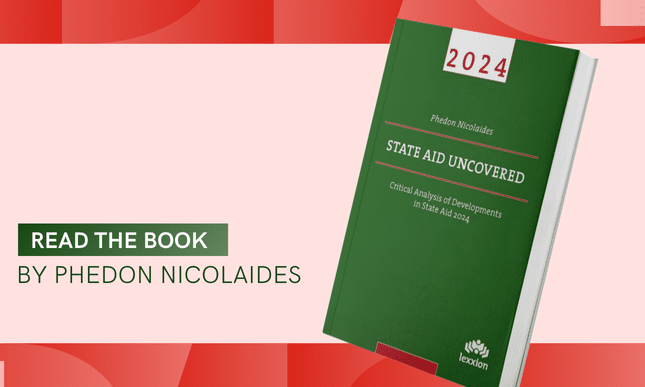
In Lexxions Blog „State Aid Uncovered” veröffentlicht Prof. Phedon Nicolaides wöchentlich kritische Analysen zu den neuesten Urteilen und Entscheidungen zu staatlichen Beihilfen. Jeder Beitrag stellt die wichtigsten Punkte eines Gerichtsurteils oder einer EU-Kommissionsentscheidung vor, ordnet sie in den Kontext ähnlicher Rechtsprechung oder Praxis ein, bewertet die zugrundeliegende Argumentation und zeigt etwaige Ungereimtheiten oder Widersprüche auf.

In loser Folge werden auf diesem Blog auch Gastbeiträge von anderen Experten für staatliche Beihilfen veröffentlicht, welche die Inhalte der Blogbeiträge ergänzen.

Jetzt abonnieren!

Professor at Maastricht University; Professor at University of Nicosia, and Academic Director at Lexxion Training

PART I: Regional Development and i) Market Economy Operator Test, ii) Services of General Economic Interest

A market economy operator undertakes activities whose incremental revenue exceeds their incremental costs. A market economy operator ignores costs which are unaffected by those activities. A service of general economic interest has special characteristics that set it apart from other services with positive impact on the economy. Having a positive impact is not enough.   Introduction National and regional authorities […]

Calculation of State Aid in Guarantees

State guarantees can be used to support loans for working capital. The amount of State aid in guarantees can be calculated to remain below the de minimis threshold of EUR 200,000.   Introduction With financial instruments being very much in vogue, there is much interest in the use of guarantees and loans as a means of granting State aid. Therefore, […]

Court’s Diary – May 2016

Find below the court’s diary for all State aid cases this month. Would you like to write a comment on one of them? Please don’t hesitate and get in touch with us ([email protected]), we are happy to publish your comment on the blog.   Tuesday 10/05/2016 Judgment in Case T-47/15 – Germany v Commission (General Court – Third Chamber)   […]

Who is Aided when a Bank is Resolved?

Bank resolution may involve State aid. However, the depositors do not normally benefit from State aid, nor do the buyers of the viable assets, if they pay a market price. Any aid normally goes to the remaining, non-performing, assets that are eventually liquidated.   Introduction The new bank resolution regime that came into force on 1 January 2016 aims to […]

The Private Creditor Test: All Options Must be Taken into Account

A private investor always takes into account all available information before it makes any investment. Similarly, a private creditor takes into account all available options for recovering the largest possible amount of the money that is due. Such options may include different legal procedures. In assessing alternative options, a private creditor considers not only the amount that may be recovered, […]

Local Infrastructure

Public funding of local infrastructure is not State aid when the responsibility for the infrastructure falls within the remit of public authorities, it is not commercially exploited, it is open to all users, it is not intended to support the needs of any particular undertaking and any benefits to any undertaking are incidental.   Introduction Even since the adoption of […]

Court’s Diary – April 2016

Find below the court’s diary for all State aid cases this month. Would you like to write a comment on one of them? Please don’t hesitate and get in touch with us ([email protected]), we are happy to publish your comment on the blog.   Thursday 14/04/2016 Judgment in Case C-100/15 P – Netherlands Maritime Technology Association v Commission (Court of […]

The Treatment of Advisory and Information Services under State Aid Rules: The Case of the German Milk Levy

Public funding of advisory and information activities may constitute State aid. Public funding of industry associations may constitute State aid.   Introduction An article that was published on this blog in January (view the article HERE) dealt with the issue of compulsory tests. If tests which are intended to safeguard public health are paid for by the state, is there any […]

Compensatory Payments Can still Confer an Advantage

Membership of a compulsory insurance scheme can still confer an advantage to participating undertakings. Private contributions can still become state resources if they are paid into a fund that is managed by the state. Member States always have the option to ask for a measure to be assessed directly on the basis of the Treaty but they have to justify […]

a) Natural Disasters and b) Absolute Impossibility to Recover Incompatible State Aid

Aid to remedy the damage caused by natural disasters can be granted only if the damage is the direct consequence of the disaster and the amount of aid must be limited to the actual damage suffered by each individual undertaking. Absence of documentary evidence can lead to absolute impossibility to recover incompatible aid.   Introduction Article 107(2) TFEU declares three […]

The Market Economy Investor Test Applied to a Financially Troubled Company

Public funding of an undertaking is free of State aid when it is accompanied at the same time and on equivalent terms by similar private funding. If public funding is provided at the insistence of the private investors, it cannot be considered to be “pari passu” with the private participation. Public funding into a financially troubled company can still be […]

A Measure is Selective if its Application is Narrower than the Scope of the Objective it Seeks to Achieve

A measure is attributed to a decision of a Member State if it is allowed but not mandated by an EU directive. A measure is selective when in practice it is open to fewer undertakings than the ones to which it can potentially apply by its own defined objectives. Introduction   This article examines Commission Decision 2014/686 on a guarantee […]

i) State Aid Can Be Attributed to the State even when Granted via Faulty Procedures ii) Who Can Challenge a Commission Decision Authorising State Aid?

For a measure to constitute State aid, it must, among other things, be attributed to a decision of the state. When a State aid granting decision is made in contravention of the procedural rules of an organisation controlled by the state, the decision can still be attributed to the state, unless it can be shown that the state would have […]

Advantage from High Entry Prices: Can It Be That Both the Commission and the General Court Have Misunderstood Simple Economics?

Price regulation can constitute State aid if the state forgoes potential revenue. However, for price regulation to constitute State aid it must satisfy all of the criteria in Article 107(1). Price regulation that affects all competitors proportionately does not confer an advantage and therefore does not constitute State aid. Introduction   On 11 September 2014, the General Court, in case […]

i) Domestic Legal Problems Do Not Make the Recovery of Incompatible Aid Absolutely Impossible ii) Role of National Courts in Cases of Non-notified Aid

The only defence for non-recovery of incompatible State aid is absolute impossibility. Obstacles in domestic legal proceedings may result in absolute impossibility, but Member States have an obligation to inform the Commission and national courts have to seek guidance from the Court of Justice of the European Union. Introduction   This article deals with two aspects of the recovery of […]

The Jurisdictional Side of Selectivity

A measure determined independently by similar public entities is not selective even if it varies across those entities. A measure is selective when the entity that has adopted it, applies it differently to undertakings which are within its jurisdiction and in a comparable situation. A public entity may differentiate its measures provided the differentiation can be objectively justified. Introduction   […]

Restructuring Aid Approved on Condition that the Beneficiary Is Sold to Highest Bidder

The Commission has wide discretion in assessing the compatibility of State aid with the internal market. Each case is assessed on its own merits and, therefore, the Commission is not bound by precedents or decisions on previous cases. Sale of shares held by public authorities may be required if divestment is necessary for long-term viability of aid beneficiary. Introduction   […]

Simultaneity of Investments by Public and Private Investors is a Necessary but not Sufficient Condition for Public Investments to be Free of State Aid

If a public authority guarantees a loan to a company that is in financial difficulty and charges a low premium, the whole loan, not just the difference between the market rate of premium and the rate actually charged, will be considered to be State aid. Simultaneous capital injection by public and private investors is not enough to eliminate State aid […]

Not Surprisingly, Another Member State Fails to Prove Compliance with the Altmark Criteria

Maintaining capacity that is necessary for the provision of normal services cannot be classified as a service of general economic interest. State aid may not be granted towards the costs of cleaning up pollution caused by the aid recipient itself. State aid to a legal monopoly may still affect trade if there is competition for the monopoly rights or if […]

Compensatory Payments Can be State Aid

Article 107(1) also applies to payments that offset the damage caused by natural disasters. It is irrelevant that the compensation is partial or that competitors did not suffer similar damage. A measure can be State aid even if it is partially or wholly funded by private resources. It is sufficient that the resources come under state control. A measure is […]

Sie möchten einen Beitrag einreichen oder zur Weiterentwicklung des Blogs State Aid Uncovered beitragen? Weitere Details finden Sie auf der englischsprachigen Seite.

Gastbeitrag einreichen

Abonnieren Sie unseren Newsletter für aktuelle Informationen zu Entwicklungen, Konferenzen, Seminaren und Veröffentlichungen in Ihrem Interessenbereich.

Newsletter: Jetzt abonnieren